News
The Nuclear Ban Treaty at five years - Peace Boat at the first Review Conference
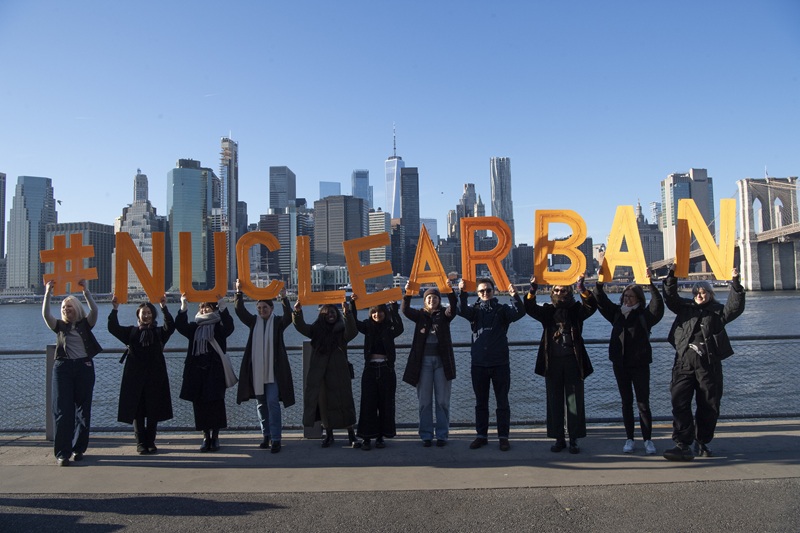
Today, amid renewed geo-political tensions and regional conflicts, the risks of nuclear weapons use are arguably the highest they have ever been since the end of the Second World War. Yet even as some governments signal new investments in nuclear arsenals, a coalition of nations, civil society organisations and international institutions are advancing a different vision, anchored in the Treaty on the Prohibition of Nuclear Weapons (TPNW), which went into effect five years ago.
States Parties to the TPNW will meet and review progress on the treaty at its first Review Conference from 30 November - 4 December 2026, at the United Nations Headquarters in New York. Peace Boat will also be present, together with the International Campaign to Abolish Nuclear Weapons (ICAN), and partner organisations and nuclear survivors from around the world. In addition to participating in the main conference, Peace Boat will present a working paper and statement addressing the impacts of nuclear weapons from a gender perspective.
Cooperation as part of the Japan Campaign to Abolish Nuclear Weapons
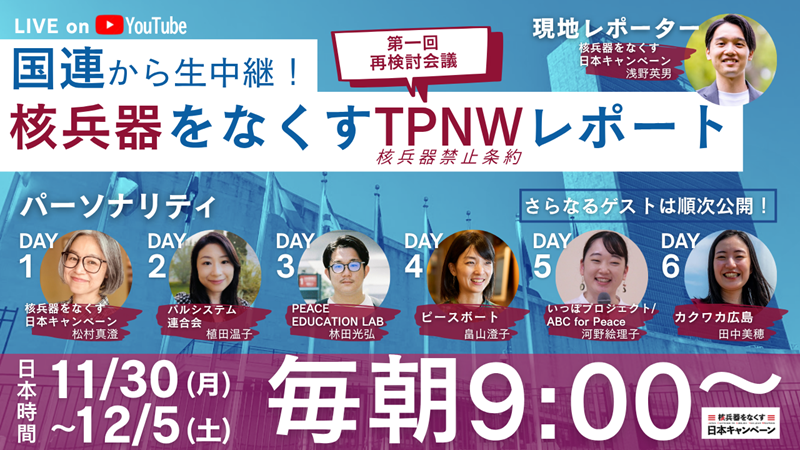
As part of the Japan NGO Network for Nuclear Weapons Abolition, Peace Boat will collaborate with other Japanese civil society organizations, experts and youth attending the Review Conference organising daily livestream events linking New York and Japan and providing updates to the Japanese public and media. Click here for information about these events and to watch online (in Japanese language).
We will also support the participation of representatives from six Japanese political parties at the Parliamentarians’ Forum convened at the United Nations by ICAN on December 1, including providing interpretation.
Nuclear Justice: Solidarity with Survivors
Representatives of communities whose health and environment have been affected by nuclear weapons, including Hibakusha of Hiroshima and Nagasaki, will gather in New York to take part in the meeting and collectively share their experiences and discuss their fights for justice.
Peace Boat will support the participation of Nihon Hidankyo at the Review Conference including through providing interpretation, and will also connect with partners from nuclear affected communities around the world.
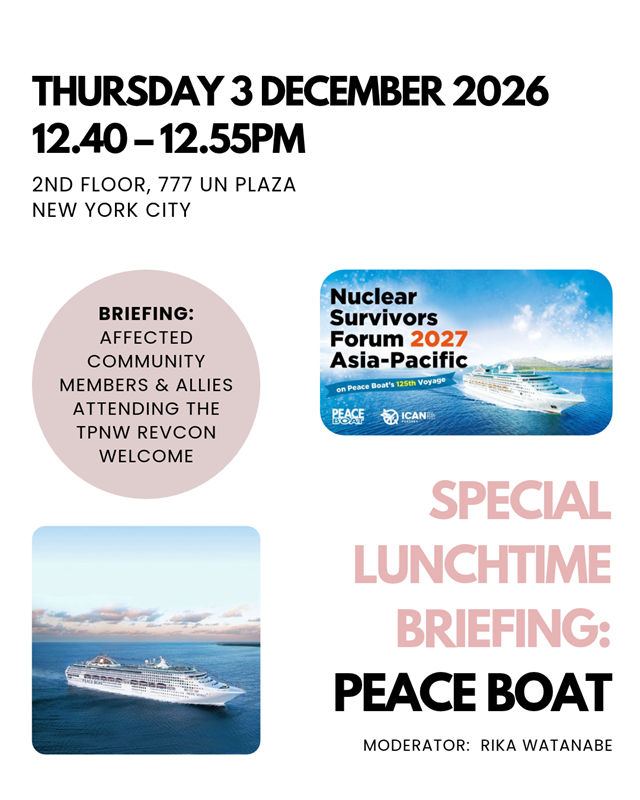
We will also present a special lunchtime briefing at the Community Hub organised by the Nuclear Truth Project on Thursday December 3 from 12:40pm at the 2nd floor of the CCUN, 777 UN Plaza. Here, Watanabe Rika will introduce the Nuclear Survivors Forum 2027 in Asia-Pacific, which invites passionate young advocates and practitioners from nuclear-affected communities in the Asia-Pacific region to join a unique programme aboard our 125th Global Voyage, between March 18 and March 30, 2027. Learn more about the briefing and Community Hub here, and the 2027 programme here.
The Nuclear Threat and Northeast Asia
Peace Boat will also collaborate with Korean and Mongolian civil society organisations to hold a joint Side Event focusing on the situation on the Korean Peninsula and in Northeast Asia, with details as below.
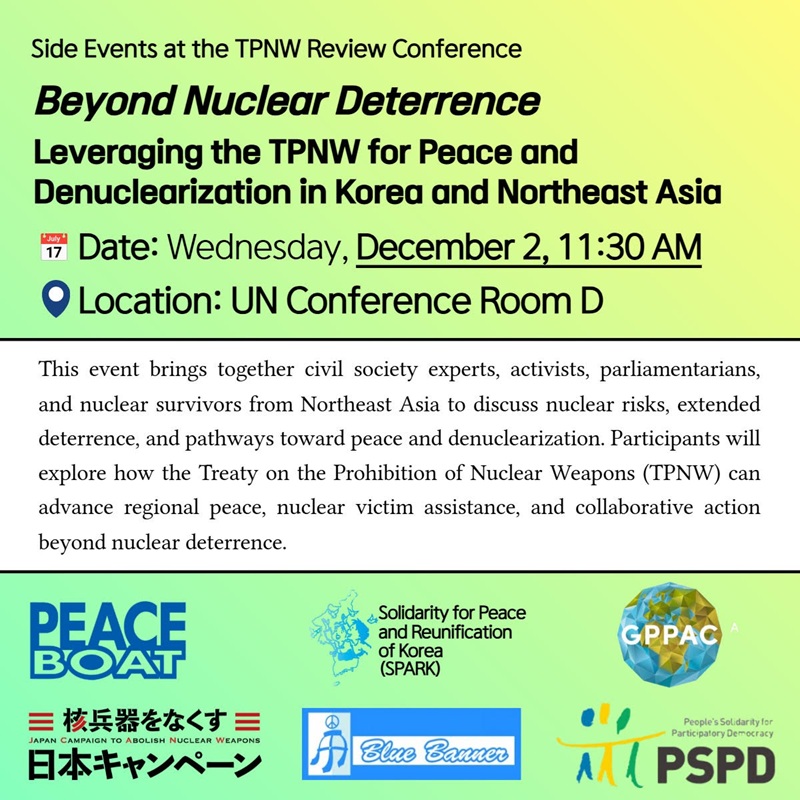
Beyond Nuclear Deterrence: Leveraging the TPNW for Peace and Denuclearization in Korea and Northeast Asia
Peace Boat and Solidarity for Peace and Reunification of Korea (SPARK), in cooperation with the Global Partnership for the Prevention of Armed Conflict (GPPAC), Japan Campaign to Abolish Nuclear Weapons, Blue Banner and People’s Solidarity for Participatory Democracy (PSPD).
Wednesday, 2 December at 11:30 slot in Conference Room D
This side event brings together civil society experts, activists, parliamentarians, and Hibakusha (nuclear survivors) from Northeast Asia to address the urgent nuclear dynamics of the region—including the Korean Peninsula, expanding military capabilities, and extended nuclear deterrence reliance. Through this critical regional lens, participants will discuss pathways toward peace and denuclearization, examining perspectives from non-signatory states like Japan and South Korea alongside Mongolia's unique single-state nuclear-weapon-free status. The session will highlight strategies for leveraging the Treaty on the Prohibition of Nuclear Weapons (TPNW), addressing regional victim assistance needs, and advancing collaborative steps toward confidence-building and lasting peace beyond alliance-based nuclear security.