News
15 Years Since 3.11 - Toward a Society that Protects Human Rights, Not Nuclear Restart
March 11, 2026, marks 15 years since the Great East Japan Earthquake and Tsunami and the subsequent TEPCO Fukushima Daiichi Nuclear Power Plant disaster. As memories fade, the Japanese government is moving to accelerate the restart of nuclear reactors. However, tens of thousands of evacuees remain displaced. The legal responsibility for the disaster remains unresolved in court, and the outlook for decommissioning including the removal of fuel debris remains bleak.
In response to this situation, Peace Boat continues to work persistently toward a world without nuclear power or weapons, collaborating with disaster survivors in Fukushima and international partners dedicated to creating a nuclear-free world.
Voices from Fukushima
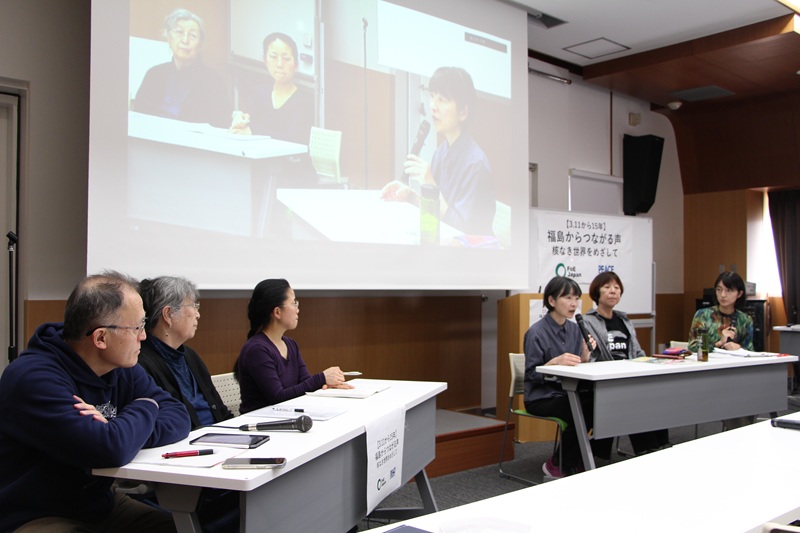
On March 1, 2026, Peace Boat and the international environmental NGO FoE Japan co-held an international symposium in Tokyo titled "Voices Connecting from Fukushima, for a Nuclear-Free World." The event aimed to share the current reality of the ongoing damage and reaffirm the path toward a nuclear-free society.
Muto Ruiko, a resident of Miharu Town in Fukushima, reflected on how iodine tablets were not distributed and SPEEDI (System for Prediction of Environmental Emergency Dose Information) data was withheld at the time of the disaster. She pointed out ongoing issues, such as TEPCO’s lack of accountability in criminal trials and the plan to use soil containing up to 8,000 Bq/kg, 80 times the previous permitted limit, as "recycled soil" for reconstruction projects.
Kawasaki Akira of Peace Boat highlighted the link between domestic nuclear issues and global nuclear threats. He pointed out how the discharge of “treated” contaminated water has become an international environmental concern for neighboring countries, and how the full-scale military invasion of Ukraine by Russia demonstrated that nuclear plants can become targets of military force, raising concerns about the nexus between international affairs and nuclear issues. Additionally, Dave Sweeney of the Australian Conservation Foundation reported that in last year’s Australian general election, the two major parties were split on the introduction of nuclear power, and ultimately, the Australian public chose the party promoting renewable energy.
8,500 Voices Call for Denuclearization at the "Stop Nuclear Power 3.7" National Rally
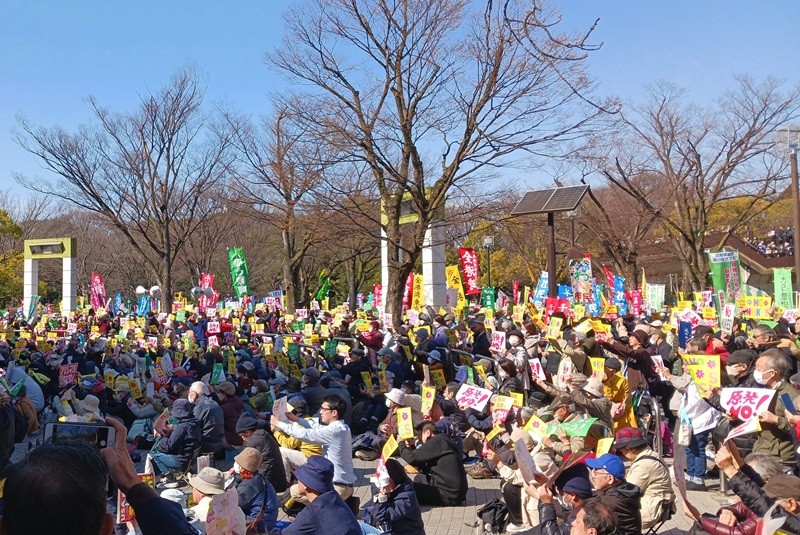
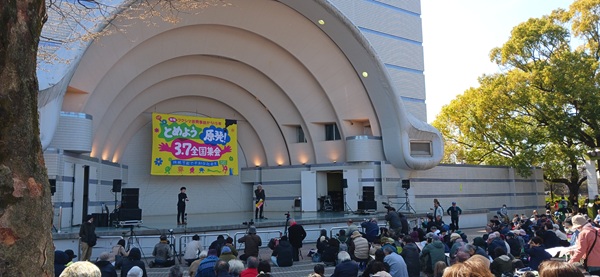
On March 7, the "Stop Nuclear Power 3.7 National Rally" was held at Yoyogi Park, organized by the executive committee of various groups including Peace Boat. Approximately 8,500 people gathered to demand an end to nuclear power.
Kamata Satoshi, a renowned journalist and founding member of "Goodbye to Nuclear Power," urged the crowd to keep speaking out even as the Japanese government pushes for restarts amid a tense international climate.
Sasaki Kanna of the Niigata Citizens’ Network, which is dealing with the restart of the Kashiwazaki-Kariwa Nuclear Power Plant, stated "In Niigata, over 140,000 signatures were collected for a provincial ordinance to hold a referendum on the restart, yet it was rejected by the assembly. I couldn't believe my ears when I heard the assembly argue that citizens 'lack the capacity to judge.' I feel strong anger toward the Governor and the Assembly for refusing even to hold a discussion. For the sake of the teenagers and those in their twenties who will carry the future, I want to create a society where no one is forced to bear the burden of these risks."
Mikami Hajime, former Mayor of the city of Kosai and member of the "Mayors for a Nuclear Power Free Japan," argued that as seen in Ukraine, nuclear plants can become targets for attack, making their existence a national security risk - emphasizing that the government should focus on renewable energy as a growing industry, rather than the declining nuclear industry. Peace Boat’s Kaneoya Haruna served as the moderator for the event.
Fukushima Action Project Screens Documentary - "The Truth Behind “The Political Removal of the Governor”"
The citizens' group Fukushima Action Project, which works to ensure radiation education in Fukushima does not return to "safety myths," screened the documentary "The Truth Behind “The Political Removal of the Governor” at Forum Fukushima from October 10 to 16, 2025. The film focuses on the late Sato Eisaku, former Governor of Fukushima and advisor to the project. Peace Boat is a member of the Fukushima Action Project.
Sato Eisaku (Governor from 1988–2006) took a remarkably firm stance, challenging the national government’s nuclear policy and pluthermal project from the perspective of local autonomy. In 2006, he was accused of bribery by the Tokyo District Public Prosecutors Office, resigned, and was arrested. However, while the Supreme Court ruled in 2009 that the "amount of the bribe could not be specifically calculated," a guilty verdict was still handed down. The documentary explores the behind-the-scenes reality of what led to the arrest of the former governor.
The screening was a major success, with standing room only for many sessions. Participants shared memories of the former governor, mourning him while wondering how Fukushima might have fared in 2011 had he still been in office.
Supporting the "Mayors for a Nuclear Power Free Japan"
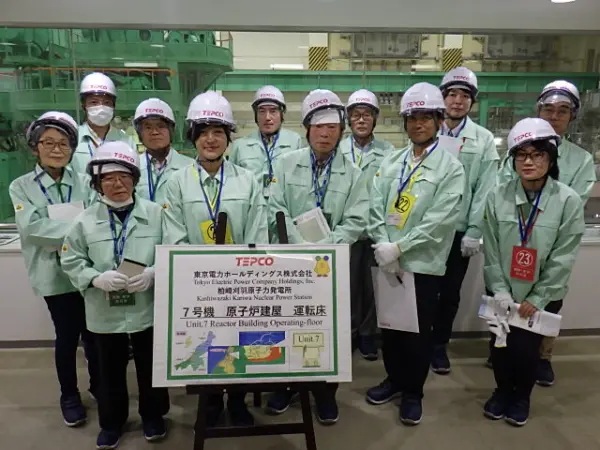
Mayors for a Nuclear Power Free Japan, an organization composed of current and former heads of Japanese local governments visited the Kashiwazaki-Kariwa Nuclear Power Plant in Niigata in May 2025, held a study session on the dangers of its restart, and passed an emergency statement declaring that the plant should not be restarted due to its two major unresolved issues.
In October of the same year, the group co-hosted an online seminar with the Federation for Promotion of Zero-Nuclear Power and Renewable Energy (Genjiren), and invited Professor Emeritus/Specially Appointed Professor Asuka Jusen of Tohoku University to speak on the topic "Is nuclear power really necessary due to rising electricity demand from data centers and AI? The reality of nuclear power worldwide." Following this, they issued a joint statement at a press conference, stating that the claim that nuclear power is necessary for AI demand is false, and demanding the abandonment of new nuclear construction based on supposedly innovative light-water reactors. Peace Boat serves as the secretariat for Mayors for a Nuclear Power Free Japan.