

News
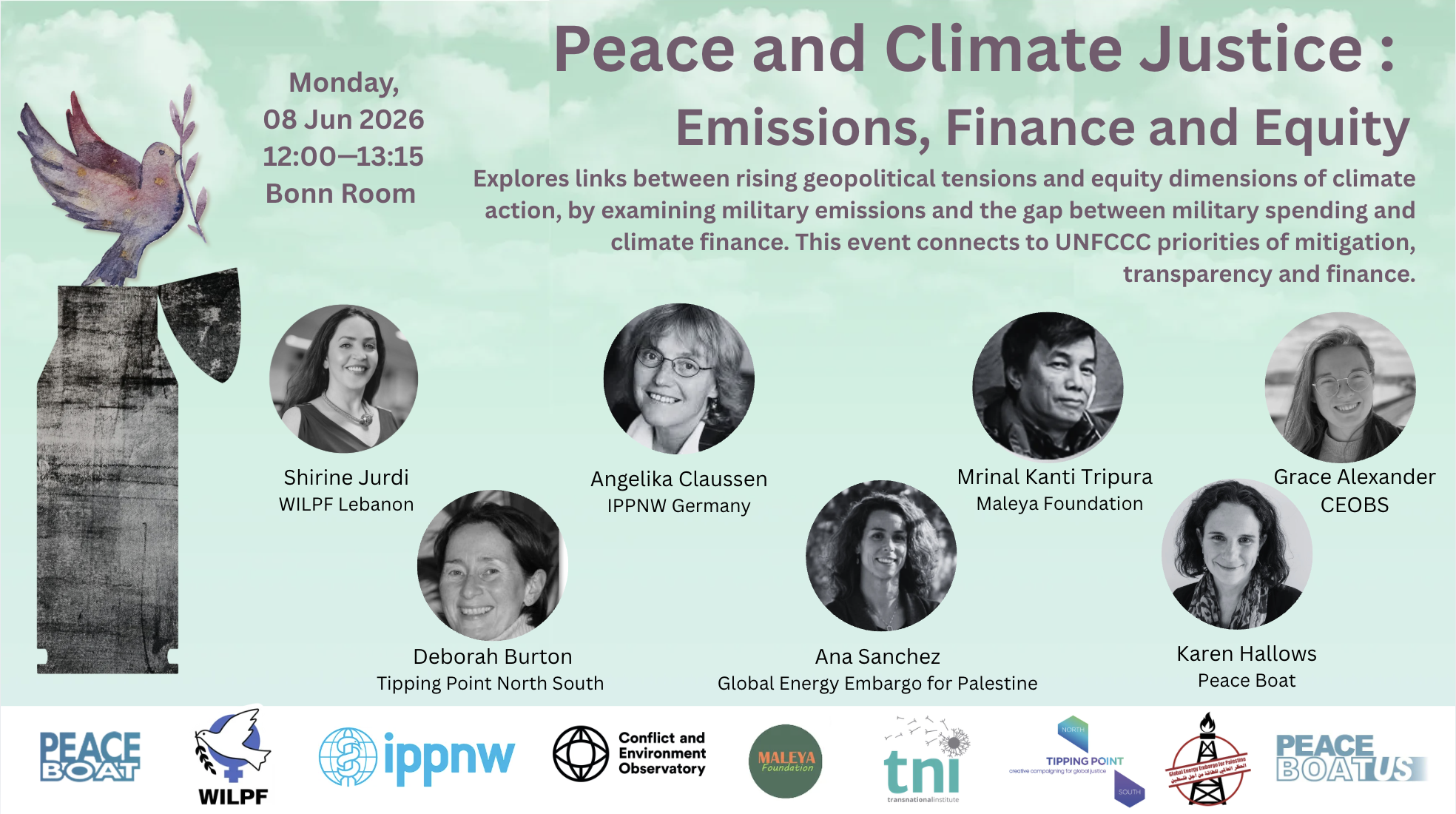
Peace and Climate Justice: Emissions, Finance and Equity- Side Event at UNFCCC SB64
Peace and Climate Justice: Emissions, Finance and Equity
UNFCCC SB64 Side Event
Monday, 8 June 2026 | 12:00–13:15 | Bonn, Germany
As governments, civil society organisations, scientists and negotiators gather in Bonn for the 64th Sessions of the UNFCCC Subsidiary Bodies (SB64), Peace Boat and partners will host a side event exploring the connections between militarism, climate change, peace, and global justice.
The event will examine military greenhouse gas emissions, the growing gap between military spending and climate finance, the links between fossil fuels and conflict, the risks posed by nuclear weapons, and the disproportionate impacts of insecurity and violence on frontline communities. It is organized by Women's International League for Peace and Freedomg (WILPF), Internatiional Physicians for the Prevention of Nuclear War (IPPNW), Maleya Foundation, Transnational Institure and Peace Boat,
The discussion connects directly to key UNFCCC priorities on mitigation, transparency, finance and equity.
About the Event
This event comes at a moment when escalating climate impacts are unfolding alongside rising geopolitical tensions, record military spending, renewed nuclear threats, and growing competition over land, energy, and resources.
Around the world, governments are investing unprecedented sums in military expansion, fuelling a new global arms race at a time when climate finance commitments continue to fall far short of what is needed for mitigation, adaptation, and loss and damage. Global military expenditure reached a record US$2.88 trillion in 2025, while many climate-vulnerable communities continue to struggle to access the resources needed to respond to the climate crisis.
At the same time, many greenhouse gas emissions linked to military activities remain hidden or underreported, despite the urgent need for transparency and accountability within global climate governance. The climate negotiations taking place in Bonn cannot be separated from the realities unfolding beyond the conference venue. Questions of war, peace, resource competition, displacement, human rights, and public spending all have profound implications for climate action and climate justice.
This side event will explore how militarisation intersects with core UNFCCC priorities, including mitigation, transparency, finance and equity. Speakers will examine the climate impacts of military activity, the lack of comprehensive emissions reporting, the diversion of public resources away from climate finance, and the disproportionate impacts of conflict and insecurity on frontline communities.
The discussion will also address the links between fossil fuels, militarism and conflict, including questions of energy justice and global accountability. Speakers will explore how energy systems, resource extraction and geopolitical competition contribute to both climate breakdown and human rights violations.
The event will further examine the connections between militarism, nuclear weapons, nuclear power and climate risk. At a time of renewed nuclear threats, growing investment in nuclear arsenals, and increasing efforts to promote nuclear energy within climate policy spaces, important questions remain about environmental impacts, public health, intergenerational justice, and the future we are building in response to the climate crisis.
From a feminist perspective, militarism and climate injustice are deeply interconnected. Both are rooted in systems that prioritise extraction, control and inequality over care, cooperation, human rights and collective wellbeing. Women, Indigenous peoples, displaced communities and those living in conflict-affected regions are often on the frontlines of both climate impacts and militarised violence.
Through perspectives from Bangladesh, Lebanon, Palestine and the wider climate justice movement, the session will highlight how militarisation exacerbates climate injustice and undermines efforts to build a more equitable and sustainable future.
As governments continue to expand military budgets while climate finance remains inadequate, the discussion will ask whether current political priorities are compatible with achieving climate justice, and what greater transparency, accountability and international cooperation could look like in practice.
About the UNFCCC Subsidiary Bodies (SB64)
The Subsidiary Bodies meetings are held each year under the United Nations Framework Convention on Climate Change (UNFCCC). Often referred to as the "SBs," these sessions bring together governments, UN agencies, researchers and civil society organisations ahead of the annual COP climate summit.
The meetings in Bonn are a key space for advancing technical negotiations and political discussions related to implementation of the Paris Agreement, including mitigation, adaptation, climate finance, transparency and loss and damage.
Alongside the formal negotiations, side events provide opportunities for dialogue, knowledge sharing and engagement between negotiators, experts and civil society.
Speakers
- Grace Alexander (Conflict and Environment Observatory)
- Deborah Burton (Tipping Point North South)
- Mrinal Kanti Tripura (Maleya Foundation)
- Shirine Jordi (Women's International Leage for Peace and Freedom, Lebanon)
- Ana Sanchez (Global Energy Embargo for Palestine)
- Angelika Claussen (International Physicians for the Prevention of Nuclear War, Germany)
- Karen Hallows (Peace Boat) – Moderator
The session will also include a screening of excerpts from Earth’s Greatest Enemy and an interactive audience discussion.
Join the Discussion
We warmly invite delegates, observers, activists, researchers and negotiators attending SB64 to join this timely conversation on peace, climate justice and human security. Accreditation through the UNFCCC for the SB64 is necessary to access the venue.
Peace and Climate Justice: Emissions, Finance and Equity
Monday, 8 June 2026
12:00–13:15
UNFCCC SB64, World Conference Centre, Bonn, Germany