

News
“Voices Connecting from Fukushima, for a Nuclear-Free World” Symposium Held in Tokyo
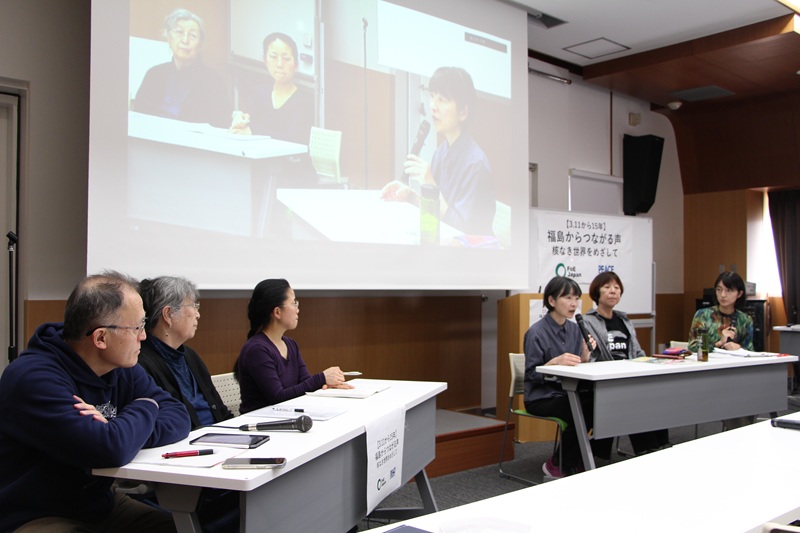
This year marks 15 years since the March 11, 2011 Great East Japan Earthquake and Tsunami, and the subsequent TEPCO Fukushima Daiichi Nuclear Power Plant disaster. Throughout this period, Peace Boat has collaborated with local communities in Fukushima and across the globe to strive for a society free from nuclear power and nuclear weapons.
On March 1, Peace Boat and the international environmental NGO FoE Japan held an international symposium in Tokyo to share the current reality of the ongoing damage and to reaffirm our path toward a nuclear-free society.
Passing on the lessons of the nuclear disaster toward a society free from nuclear dependence
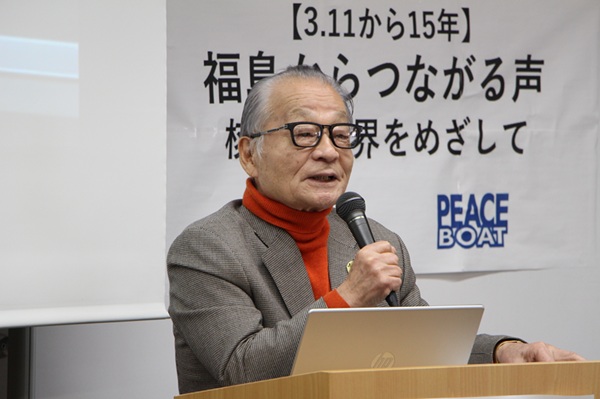
In the first session, Kawasaki Akira of Peace Boat raised concerns about the nexus between international affairs and nuclear issues, highlighting how the discharge of ALPS-treated contaminated water has evolved into an international environmental issue causing concern in neighboring countries, and pointing out that the Russian full-scale military invasion of Ukraine has shown how nuclear power plants can become targets of military force.
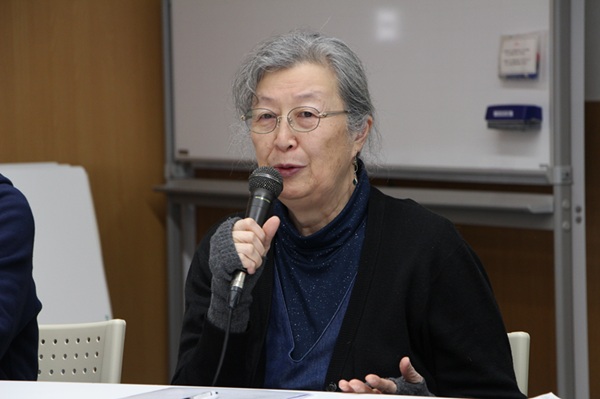
Muto Ruiko, a resident of Miharu Town in Fukushima, reflected on how iodine tablets were not distributed and SPEEDI (System for Prediction of Environmental Emergency Dose Information) data was withheld at the time of the accident. She emphasized that while media reports often cite 23,000 evacuees, municipal data indicates that 54,000 people have not yet returned, emphasizing the ongoing reality of the disaster in Fukushima even after 15 years have passed.
Yano Eriko of FoE Japan shared stories from the recreational programme "Fukushima Poka Poka Project," introducing the voices and hidden anxieties of parents and residents who initially could not evacuate, were forced to return to Fukushima due to the termination of housing support, and people experiencing 3.11 flashbacks during the COVID-19 pandemic.
Resisting the return of the "safety myth" driven by government and judicial rulings
The second session addressed the push by the Japanese government and utility companies to restart nuclear reactors despite recurring issues such as neglected malfunctions in emergency generators and data fabrication across Japan, in locations including Hokkaido, Niigata, Miyagi, Ishikawa, and Saga.
Chiwaki Miwa, who evacuated from Fukushima to Hokkaido, referred to the 2022 report by Cecilia Jimenez-Damary, the former UN Special Rapporteur on the human rights of internally displaced persons, who investigated the situation of evacuees in Japan and called for the establishment of a dedicated UN human rights body to oversee these issues.
Kawai Hiroyuki, a lawyer and member of the Federation for Promotion of Zero-Nuclear Power and Renewable Energy (Genjiren), established a national network of anti-nuclear lawyers immediately after 3.11 and has been involved in over 20 related lawsuits since. He noted that the data fabrication at the Hamaoka Nuclear Power Plant, revealed in January 2026, is currently a focal point in the judiciary. He urged citizens to continue stirring the pot of public opinion and to remain persistent in their legal and social struggles.
Toward a society prioritizing life and dignity over nuclear power
The third session featured a global discussion with voices from Taiwan, the Marshall Islands, the Philippines, Australia and Germany on the pathways toward a nuclear-free world.
Tsui Shu-hsin of Green Citizens' Action Alliance in Taiwan reported that after years of civic movements and intense debate following the Fukushima disaster, Taiwan has successfully achieved a phase-out of nuclear power.
Enrique Beren of the Nuclear-Free Bataan Movement in the Philippines reported that the Philippine government is moving to forcibly activate the Bataan Nuclear Power Plant by 2032, disregarding the voices of local residents.
Dave Sweeney of the Australian Conservation Foundation mentioned that the fuel for the Fukushima plant originated from Australian uranium, extracted from Indigenous lands without consent. He noted that in Australia’s recent general election, the public chose to support renewable energy over the pro-nuclear opposition.
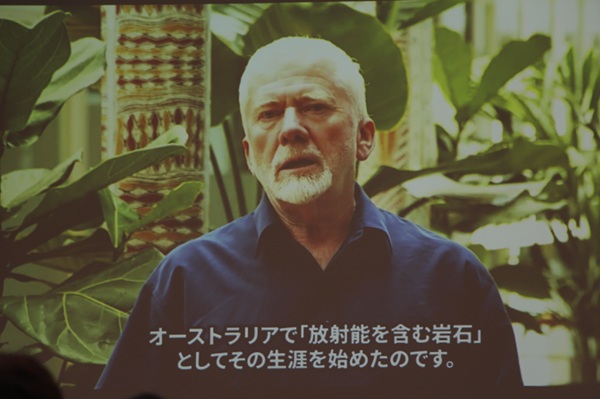
Benetick Kabua Maddison of Marshallese Educational Initiative (MEI)’s message was particularly relevant, as March 1 marked also the anniversary of the Bikini Atoll tests in the Marshall Islands, part of a total of 67 nuclear tests, the fallout from which impacted the entire Pacific Ocean including causing severe radiation exposure to Japanese fishermen.
In the same session Hatakeyama Sumiko of Peace Boat reported on Peace Boat's initiatives, including the Global Voyage for a Nuclear-Free World: Peace Boat Hibakusha Project, the Fukushima Youth Ambassador Project, and the Nuclear Survivors Forum bringing together representatives of affected communities from across Asia, the Pacific and beyond.
Juliane Dickel of Friends of the Earth Germany / BUND reported that renewables now account for approximately 60% of Germany’s electricity, and that during peak wind and solar periods in 2025, Germany temporarily achieved 100% renewable power. However, she also noted that the issue of nuclear waste remains unresolved, with site investigations for final disposal ongoing since 2017.
View this session online in English below:
This symposium provided a comprehensive update on nuclear issues from both inside and outside Japan, and an opportunity for participants to discuss efforts to promote a nuclear-free society. The discussions made it clear that nuclear power is not merely a matter of energy but directly linked to Indigenous land rights, social justice, and the destruction of culture. Keeping the lessons of Fukushima in mind, participants shared their commitment to moving toward a phase-out of nuclear energy and a world free from nuclear harm.
Peace Boat remains committed to connecting citizens worldwide and taking action to build a better, safer society.