

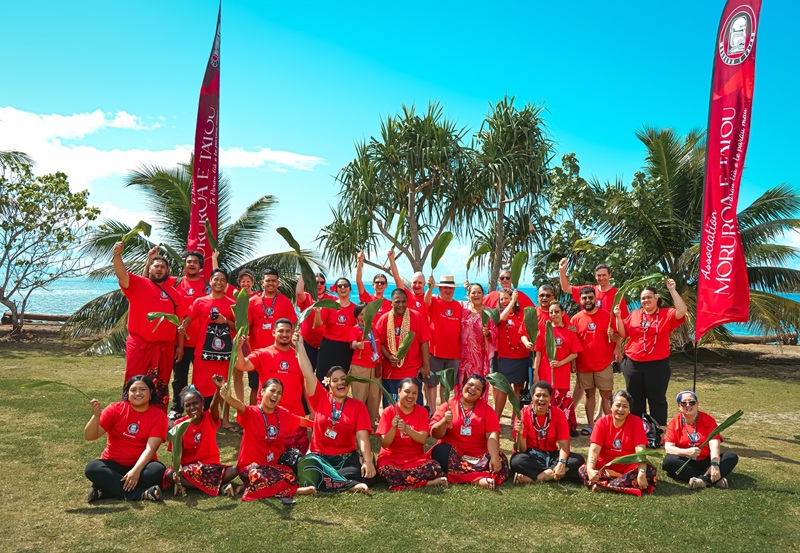
Speakers at the Nuclear & Climate Justice Week 2025
News
Peace Boat attends Nuclear & Climate Justice Week 2025 in Māòhi Nui
In November 2025, the heart of Moorea, in Māòhi Nui (French Polynesia), became the focal point for a transformative gathering: the Nuclear & Climate Justice Week 2025.
Organized by the NGO Moruroa e tātou and the Êtārētia Porotetani Māòhi, and supported by a global network including the International Campaign to Abolish Nuclear Weapons (ICAN), the Council for World Mission (CWM), the Pacific Conference of Churches (PCC), and the Okumenewerk der Nordkirche, this gathering brought together delegates from Māòhi Nui/French Polynesia, Aelōñ Kein Ad/the Marshall Islands, Kiribati, Fiji/Viti kei Rotuma, Tonga, Aotearoa/New Zealand, and regional organizations such as the Pacific Network on Globalisation (PANG), the Marshallese Educational Initiatives (MEI), ICAN France, Islands Business and Peace Boat. All were united by a shared conviction: nuclear colonialism and the climate crisis are two sides of the same violence.
A Unified Front for Nuclear Justice
The week served as a powerful opportunity to together consider the consequences of nuclear explosions, which are not only environmental; they are human, social, and intergenerational. Each day had a particular theme, for example youth leadership and climate justice.
The third day of the gathering focused on nuclear justice: “decolonizing the minds and building concrete pathways toward nuclear justice, through political, historical, scientific, spiritual, and activist voices become crucial.” This discussion was also an important mobilization point for partners of the International Campaign to Abolish Nuclear Weapons (ICAN) to discuss the Treaty on the Prohibition of Nuclear Weapons (TPNW) and its role as a critical tool for repair.
Subsequent consultations resulted in a set of concrete international demands aimed at the first TPNW Review Conference, to be held in 2026. These include the establishment of an official platform to ensure the meaningful participation of Indigenous communities and dependent territories in discussions on implementation of the treaty, creation of a Trust Fund under the TPNW (Articles 6 and 7), and accelerated funding for victim assistance and environmental remediation.
As Hinamoeura Morgant-Cross, herself a nuclear survivor, committed activist, and elected member of the Assembly of French Polynesia stated: “We carry the scars of these bombs, but we also carry the hope of a future where such tragedies will never happen again.”
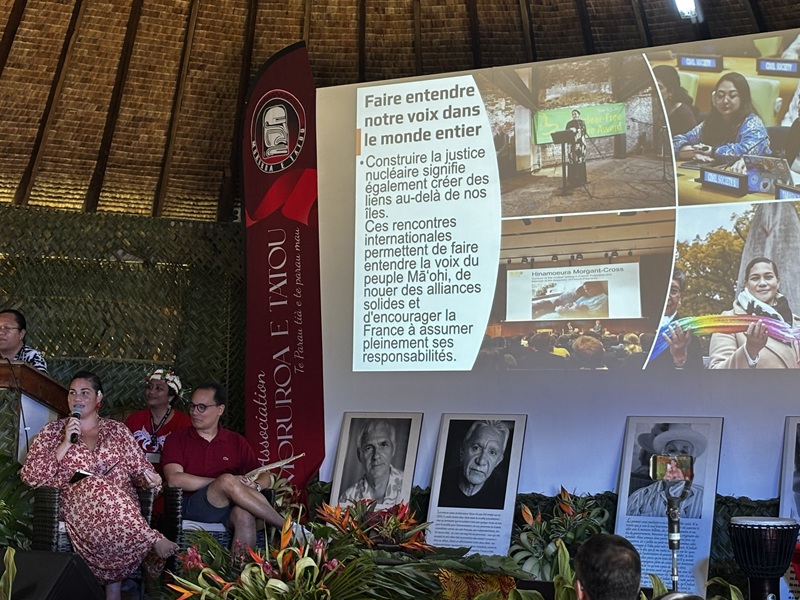
Hinamoeura Morgant-Cross shares her powerful testimony.
Linking Survivors and Grassroots Communities: People's Diplomacy
The fourth day of the gathering focused on Partnership, and Peace Boat was honoured to speak on a panel focusing on partnership and regional alliances, transnational solidarity, and the decolonization of imaginaries as essential pathways toward nuclear and climate justice. The experience of our voyages as a platform for solidarity linking nuclear survivors, island youth, and global civil society were shared, including an invitation for further collaboration during Peace Boat’s future visits to the port of Papeete. Such exchanges embody a form of people’s diplomacy rooted in memory, mutual learning, and collective action.
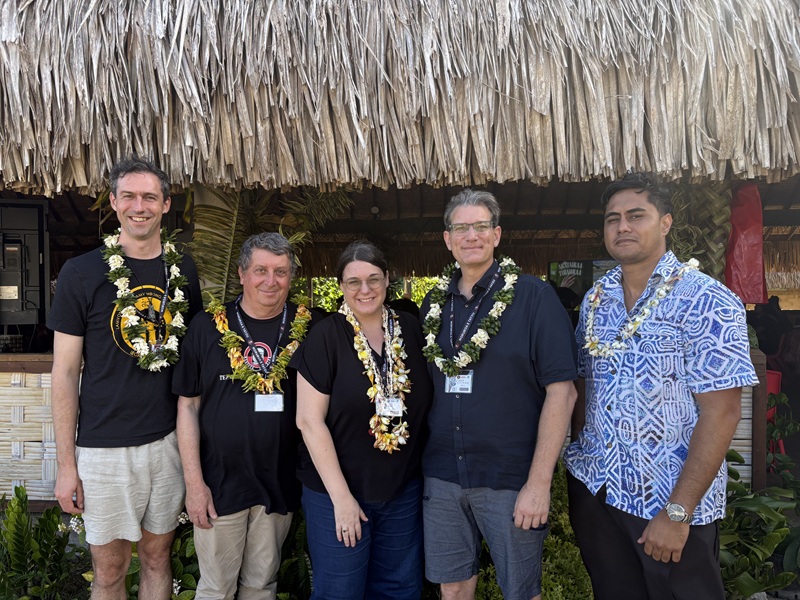
Speakers on the "Partnerships" Panel: from left, facilitator Matthew Bolton (Pace University), Nic Maclellan (Correspondent for Islands Business magazine), Meri Joyce (Peace Boat), Jean-Marie Collin (ICAN France), Hagino Erasito (Pacific Network on Globalisation, PANG).
Looking Toward 2026
The legacy of 193 nuclear tests in Māòhi Nui is now colliding with the climate crisis, creating a "nuclearized Anthropocene" where rising seas threaten to disturb radioactive sites. To combat this, delegates emphasized the need to decolonize consciousness and break the institutionalized silence surrounding nuclear history. Participants pledged to use the coming year of 2026 as a year of action, following 2025 as a year of learning.
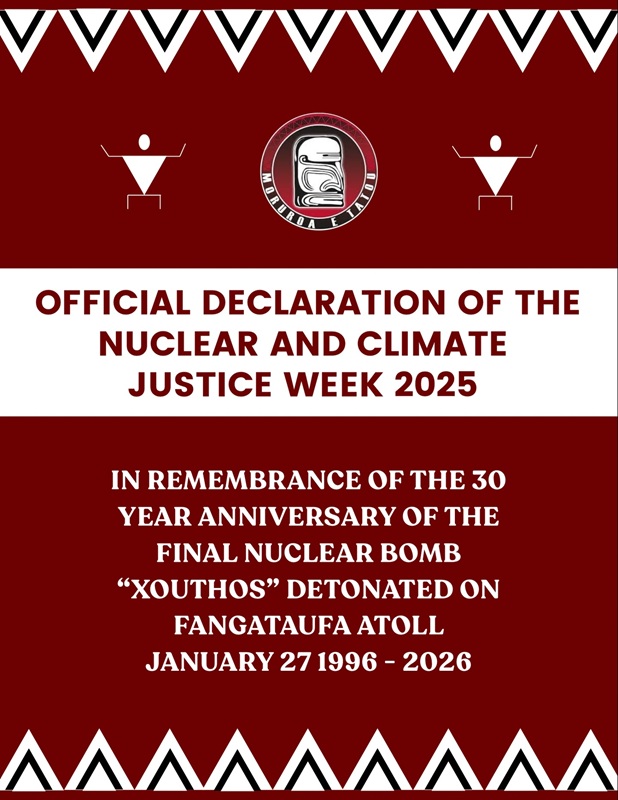
The week’s findings are encapsulated in a comprehensive [Outcome Document] (click for link), which summarizes the collective vision, commitments, and next steps agreed upon by some participants and their delegates. This document was announced on January 27, 2026, marking the 30th anniversary of the last nuclear test conducted at Fangataufa. As we approach the 60th anniversary of the first nuclear explosions in Māòhi Nui in 2026, Peace Boat remains dedicated to working with voices such as those shared during this week as they lead the way toward a future of reciprocity, autonomy, and lasting peace.
Visit Moruroa e tātou's social media pages for more images and reflections from the gathering, as well as other updates:
Facebook: https://www.facebook.com/moruroaetatou/
Instagram: https://www.instagram.com/moruroaetatou/
Our enormous appreciation to all those at the NGO Moruroa e tātou and the Êtārētia Porotetani Māòhi, the local communities and parishes in Moorea who provided such generous hospitality, the many volunteers involved in so many different ways to realise the gathering, and to the speakers and participants who shared such wisdom and experience throughout the week. We are honoured to stand together with you - Māuruuru.
All images in this report provided by the NGO Moruroa e tātou.