

News
Peace Boat at COP30: Putting Demilitarisation on the Climate Agenda
At COP30 in Belém, Peace Boat worked with partners across the peace, feminist and climate justice movements to highlight militarism as a major but still overlooked driver of climate breakdown. Military activities are estimated to produce about 5.5 percent of global greenhouse gas emissions, yet these emissions remain exempt from UNFCCC reporting and absent from national climate plans. With global military spending reaching a record 2.7 trillion dollars in 2024 while climate finance remains far below what is needed, Peace Boat and the Peace and Demilitarisation Working Group of the Women and Gender Constituency (WGC) pushed throughout COP30 to bring these issues onto the agenda.
COP30 was historic for its strong Indigenous presence and its location in the Amazon, where the impacts of extractivism and environmental degradation are visible in daily life. Despite this, militarism remained entirely outside the formal negotiations. President Lula highlighted this contradiction during his opening address, noting that it would be cheaper to solve the climate crisis with 1.3 trillion dollars than to spend 2.7 trillion dollars annually on war. Although countries agreed to create the Belém Action Mechanism to support a just transition, the conference ultimately failed to produce a fossil fuel phase out, despite widespread support. Civil society therefore played a vital role in exposing the links between militarisation, fossil fuels and climate injustice.
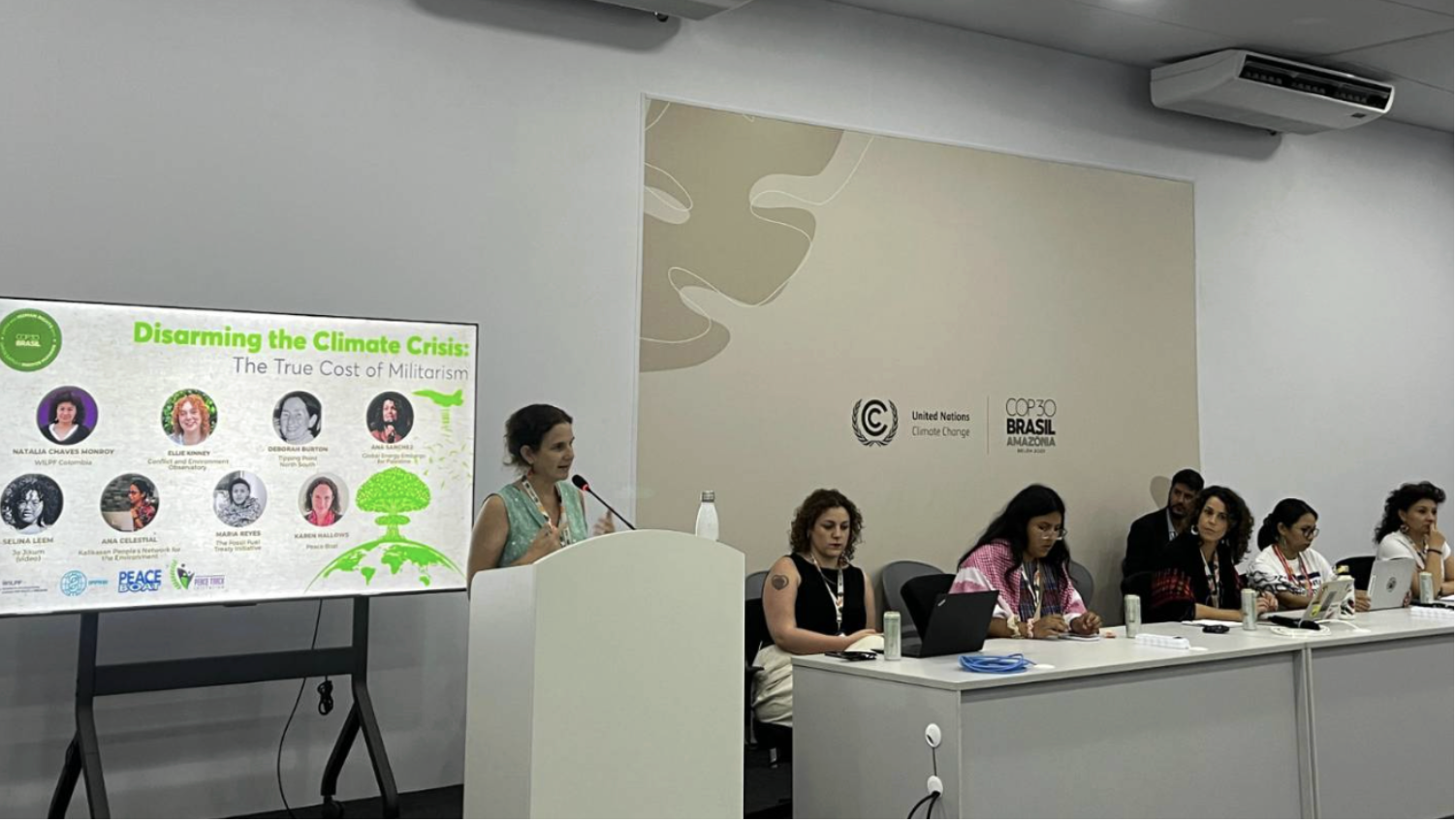
A key moment was the official UNFCCC side event “Disarming the Climate Crisis: The True Cost of Militarism,” co-organised with the Women’s International League for Peace and Freedom (WILPF), International Physicians for the Prevention of Nuclear War (IPPNW) and Peace Track Initiative. Moderated by Peace Boat’s International Coordinator, Karen Hallows, the all-woman panel explored militarism as a systemic driver of emissions and environmental harm. Ellie Kinney, Senior Advocacy Officer at the Conflict and Environment Observatory, outlined the scale of hidden and unreported military emissions. Deborah Burton of Tipping Point North South highlighted the diversion of public funds from climate action to military expansion. Maria Reyes from the Fossil Fuel Non-Proliferation Treaty Initiative described how militarisation and fossil fuel extraction reinforce one another. Natalia Chaves Monroy of WILPF Colombia addressed the dangers environmental defenders face in militarised extraction zones. Ana Sánchez of the Global Energy Embargo for Palestine explained how fossil fuels sustain occupation, while Ana Celestial of the Kalikasan People’s Network for the Environment described militarised extractivism in the Philippines. A spoken word performance by Selina Leem of the Marshall Islands highlighted the devastating and intersecting impacts of nuclear legacy and climate change on her home. This event demonstrated clearly that militarism must be recognised as a core climate issue. A full, detailed report on this session will be published separately.
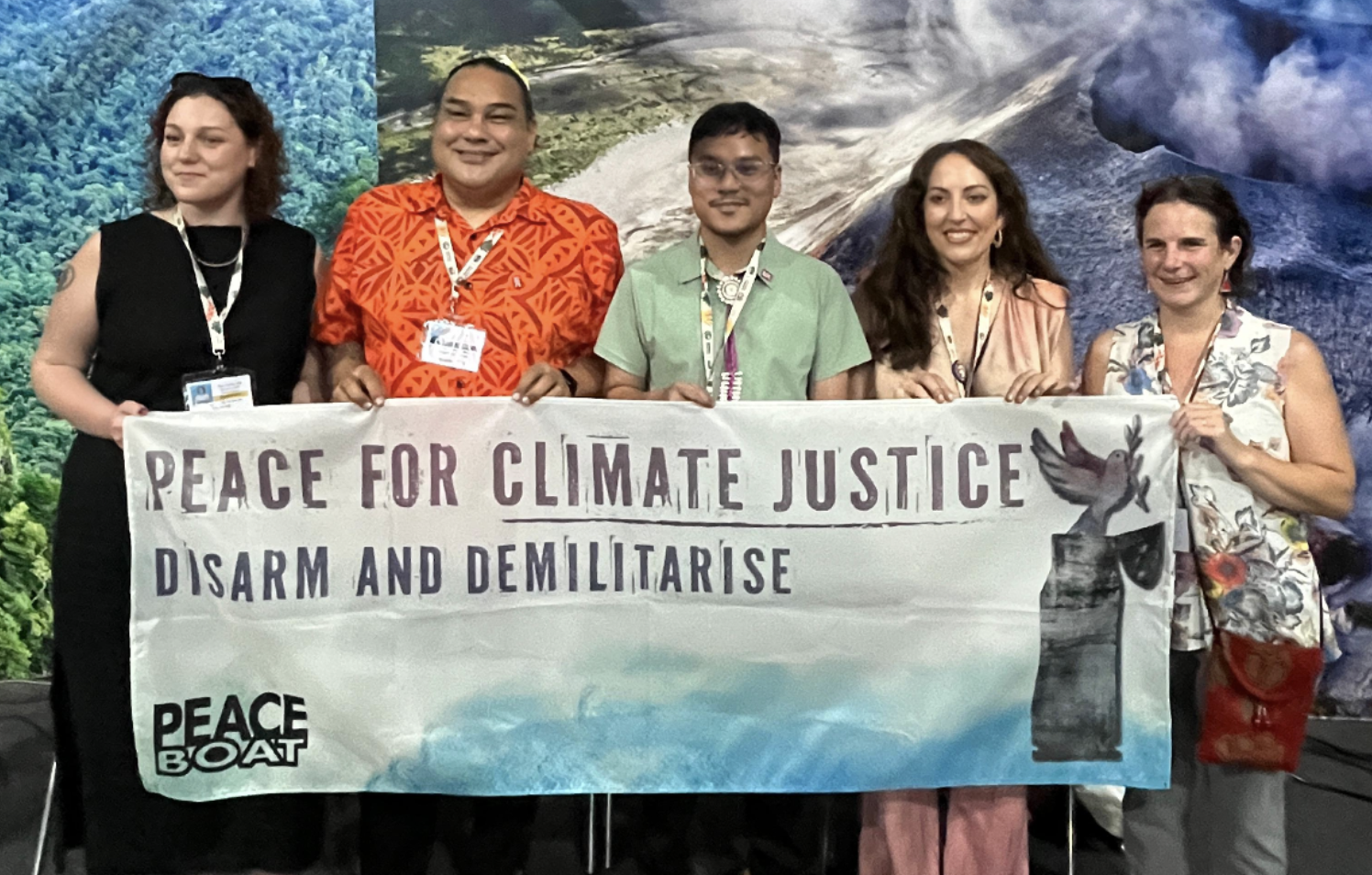
Peace Boat also brought the issue of demilitarisation to the Moana Blue Pacific Pavilion through the session “Militarism, Climate Change and the Pacific: Building Resilience, Peace and Justice,” held on 10 November. Moderator Karen Hallows opened the panel, which centred Pacific experiences and leadership. Ellie Kinney provided a global framing on military emissions and military spending. Dr James Viernes of the Pacific Islands Climate Action Network described how the Pacific continues to live with the consequences of nuclear testing, foreign military presence, colonialism and geopolitical competition. He emphasised the ways militarisation undermines sovereignty, gender justice and climate resilience. Jobod Silk, Youth Coordinator at Jo-Jikum in the Marshall Islands, spoke about the enduring radioactive legacy of nuclear testing, the existential threat of rising seas and how Jo-Jikum, as a youth-led grassroots organisation, is responding. The final speaker, Dr Amiera Sawas, Head of Research and Policy at the Fossil Fuel Treaty Initiative, explained how the Treaty, advanced strongly by Pacific nations, can be understood as a peace-oriented framework to secure a fossil fuel phase out, protect communities and reduce militarisation. The session showed the Pacific as a region where climate justice, anti-nuclear resistance and demilitarisation are deeply interconnected.
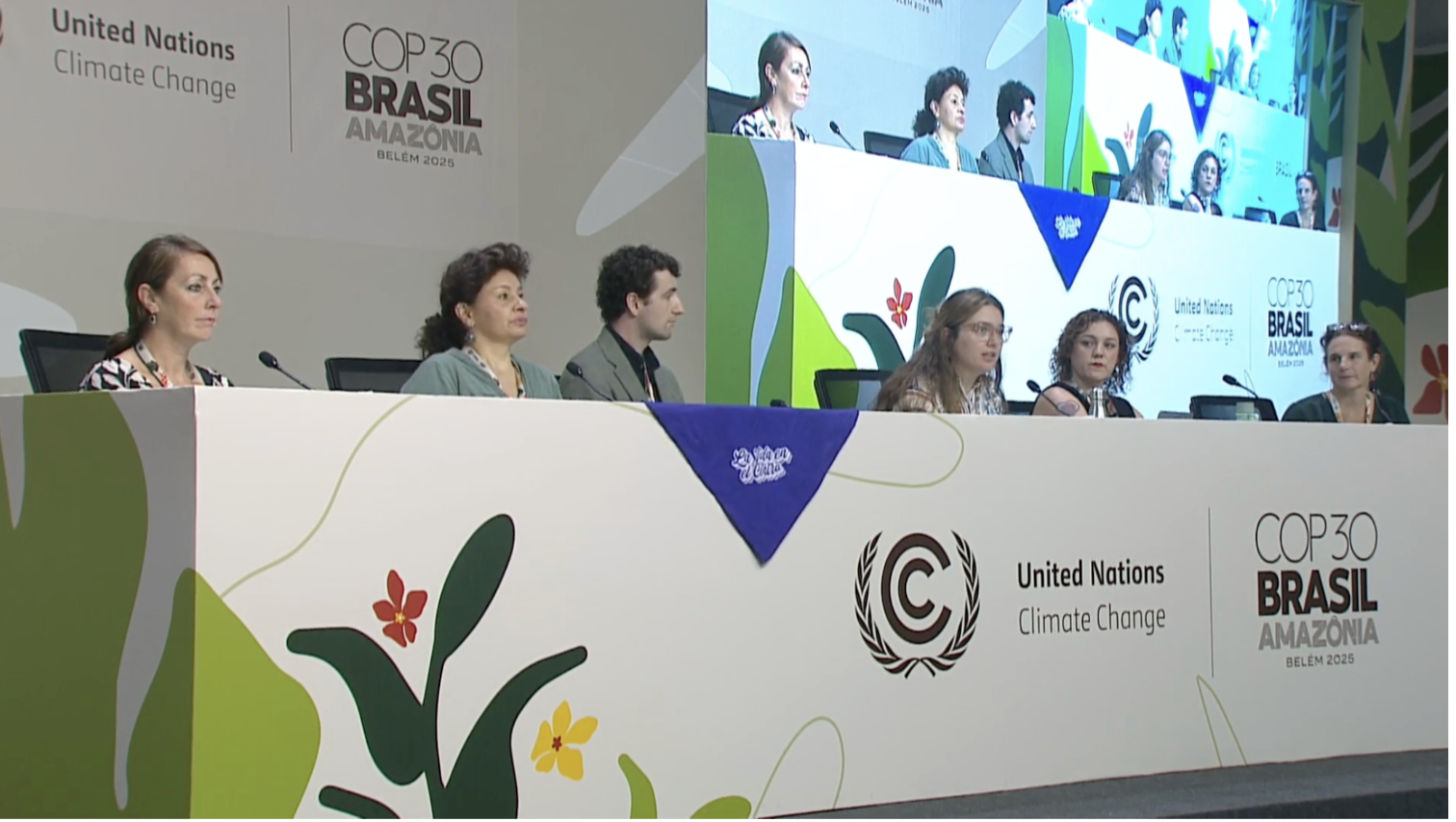
Beyond these events, Peace Boat supported the press conference “Disarming the Climate Crisis: Putting Militarism on the Agenda at COP30.” Speakers highlighted the “military emissions gap,” referring to the fact that although militaries are responsible for an estimated 5.5 percent of global emissions, which is more than the entire African continent, they are not required to report these emissions to the UNFCCC. Dr Barbara Magalhães Teixeira, a researcher in the SIPRI Climate Change and Risk Programme, spoke about global military spending. Natalia Chavez discussed extractivism in Colombia and the Fossil Fuel Treaty, while Roaa Alobeid from Sudan spoke about the intersections of the climate crisis and militarism in her home country.
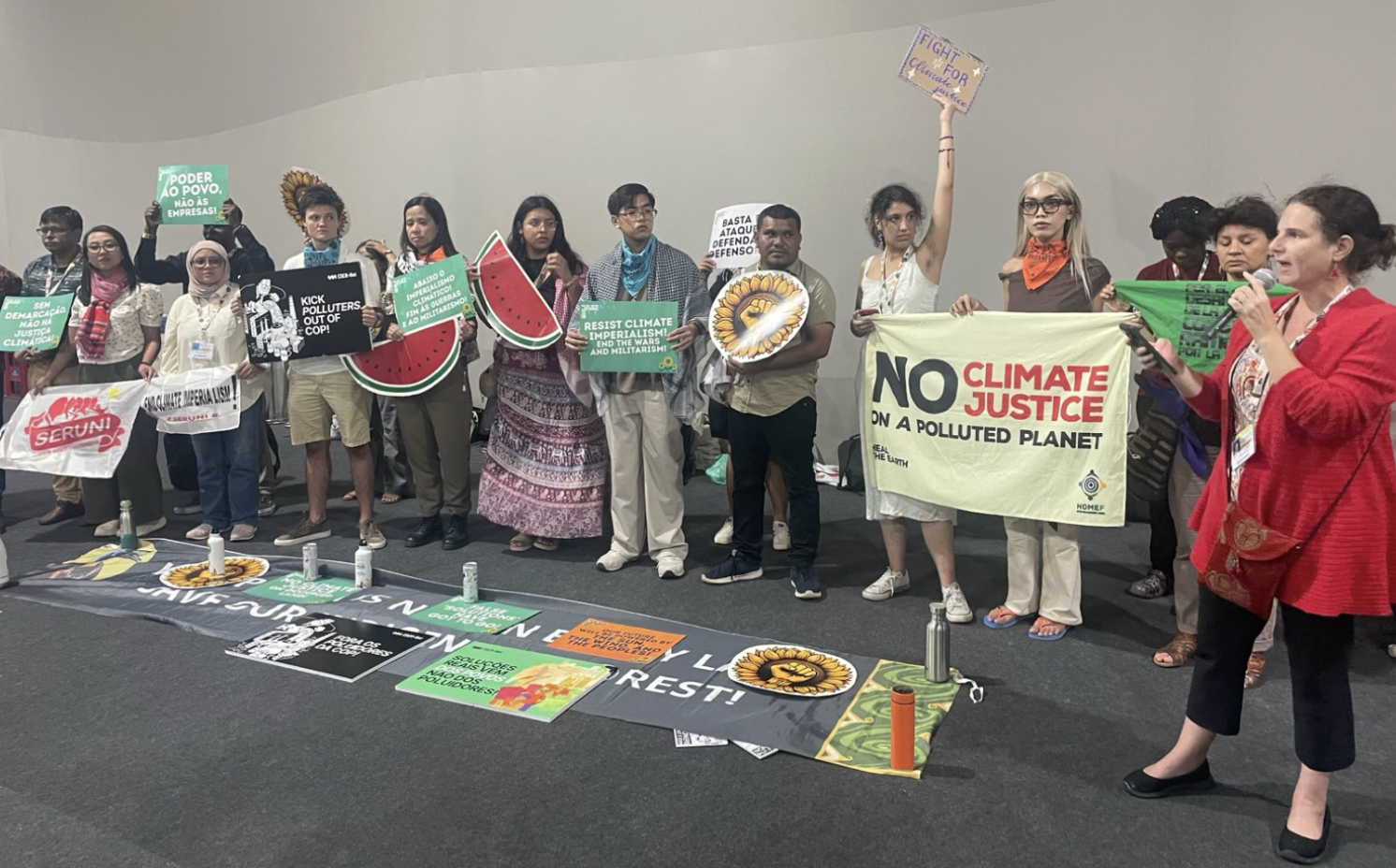
Also inside the Blue Zone, Peace Boat joined a peaceful but powerful action calling for “Money for Climate Reparations, Not War and Occupations,” which connected militarised extractivism in the Philippines, fossil fuel enabled occupation in Palestine and the broader exclusion of militarism from climate negotiations. Karen Hallows spoke during the event, stating that “Those of us from the Global North have a duty and responsibility to challenge the governments and corporations that profit from militarised destruction in our name.” The action took place under tight restrictions and reflected wider tensions between security responses and the demands of frontline communities.
Peace Boat also co-authored an article in the ECO, the civil society daily paper published by Climate Action Network International (CAN-I), which was distributed to delegates and helped bring the issue of military emissions into wider visibility among negotiators and observers.
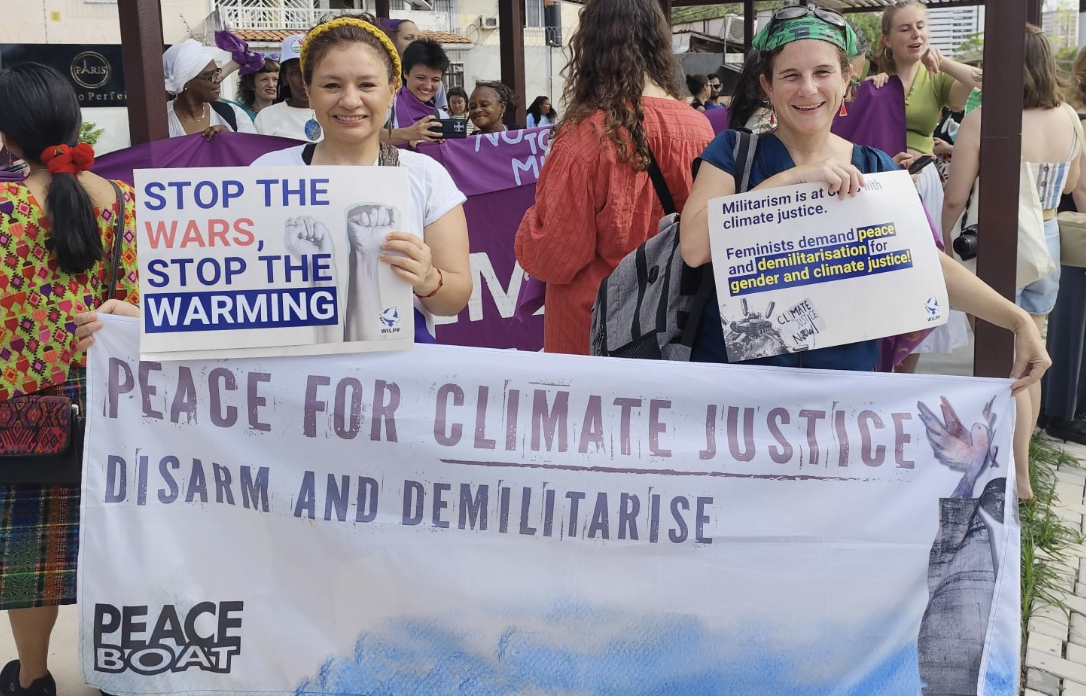
On 15 November, Peace Boat joined thousands of Indigenous leaders, youth networks, feminist groups and climate justice movements in the Climate Justice March through the streets of Belém. Marchers demanded a rapid and fair fossil fuel phase out, climate reparations, protection of the Amazon and an end to militarised violence. Peace Boat marched together with the Women and Gender Constituency, emphasising that peace and demilitarisation are essential components of climate and gender justice.
As the world looks toward COP31 in Antalya, Peace Boat will continue working with the Peace and Demilitarisation Working Group of the WGC and global allies to push for transparency on military emissions, reductions in military spending and a shift from war to climate solutions. With the failure once again to address fossil fuels at COP30, the first global conference for a Fossil Fuel Treaty, taking place in April next year, will be a key moment. It will be an opportunity to recognise that militarism, fossil fuels and the climate crisis are fundamentally interconnected. Demilitarisation is essential for delivering meaningful and just climate action.