

News
Citizens' Actions for Nuclear Abolition: Hiroshima & Nagasaki 81 Years Later
Peace Boat engaged in various activities in Hiroshima and Nagasaki this summer, marking 81 years since the atomic bombings of the two cities. On August 6 and 9, live broadcasts were streamed from the sites of Hiroshima and Nagasaki in collaboration with the International Campaign to Abolish Nuclear Weapons (ICAN), and Kawasaki Akira attended both peace memorial ceremonies on behalf of Peace Boat and ICAN. Additional activities also took place during Peace Boat’s summer voyage, which will be posted in a separate report coming soon.
Amid an extremely unstable global situation, we continue to collaborate with the Hibakusha (atomic bomb survivors) and other civil society partners to re-emphasize the critical importance of abolishing nuclear weapons.
Parliamentary Debate: Questioning Japan's Choice
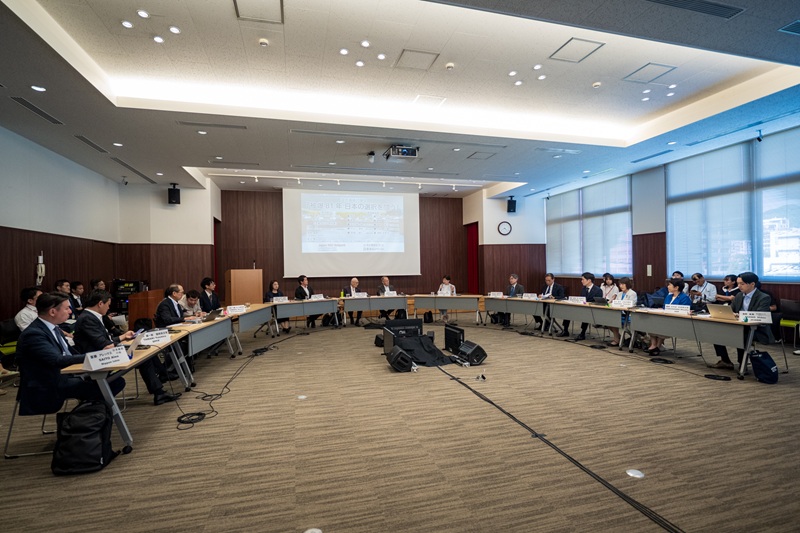
On August 5, the Japan NGO Network for Nuclear Weapons Abolition and the Japan Campaign to Abolish Nuclear Weapons (JCANW) co-hosted a panel debate in Hiroshima among members of Parliament regarding "Japan's choice" toward nuclear disarmament.
Parliamentarians representing 10 political parties, both from the ruling coalition and the opposition, gathered to discuss approaches to the First Review Conference of the Treaty on the Prohibition of Nuclear Weapons (TPNW), scheduled for November–December this year, as well as issues surrounding Japan's Three Non-Nuclear Principles.
Nakamitsu Izumi, UN Under-Secretary-General and High Representative for Disarmament Affairs, and Tanaka Terumi of Nihon Hidankyo also participated in the discussion, which was moderated by Peace Boat's Kawasaki Akira.
Participants across both ruling and opposition parties repeatedly emphasized that Japan "should adhere to the Three Non-Nuclear Principles," and representatives from 9 parties called on the Japanese government to attend the TPNW Review Conference as an observer.
High Representative Nakamitsu concluded by stating that security is not solely built on military power, but that diplomacy, dialogue, and disarmament and arms control are also vital tools. She encouraged Japan to take leadership in comprehensively combining these policies.
Citizens' Action is Crucial: Public Speaking in Hiroshima
On August 4, Peace Boat's Matsumura Masumi delivered a lecture entitled "Never Give Up on Nuclear Abolition: Living in an Uncertain Era" at a Peace Forum hosted by the Information and Telecommunications Workers' Union in Hiroshima. There, she spoke about her encounters with Hibakusha, people around the world working toward nuclear abolition, recent developments regarding the TPNW, and expectations for the upcoming Review Conference.
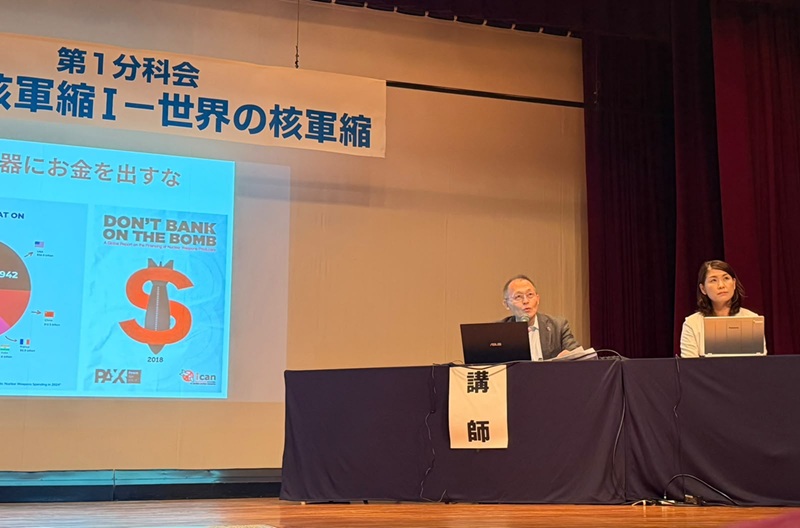
On the following day, August 5, Kawasaki Akira spoke at a panel held during the World Conference against A & H Bombs Hiroshima on the global nuclear situation and developments surrounding the TPNW.
Citizens from across Japan interested in nuclear disarmament gathered at both venues to exchange on future activities, including how to pass down the reality of the atomic bombings and how to engage younger generations.
The Power Conveyed by A-Bombed Trees
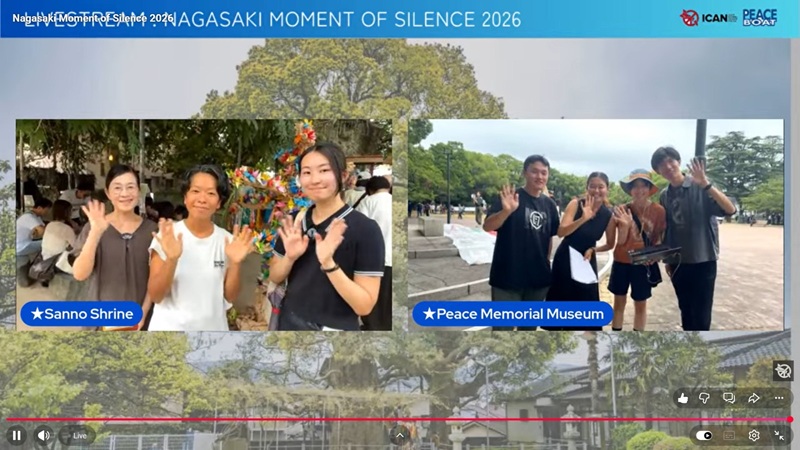
At 8:15 AM on August 6 in Hiroshima and 11:02 AM on August 9 in Nagasaki, live streams of the "Moment of Silence" were broadcast from locations in each respective city. This annual event is co-hosted by Peace Boat and ICAN, with this year's theme focusing on "Hibaku-jumoku," or A-bombed trees. Along with these trees—witnesses to the atomic bombings that convey their impact to us today—a one-minute moment of silence was observed.
In Hiroshima, together with interns from the NPO ANT-Hiroshima, we introduced a eucalyptus tree at Hiroshima Castle, camphor tree north of the castle, and the Chinese parasol tree in the Peace Memorial Park. Video testimony of the late Numata Suzuki, a Hibakusha who drew encouragement from the tree to continue sharing her story, was also broadcast.
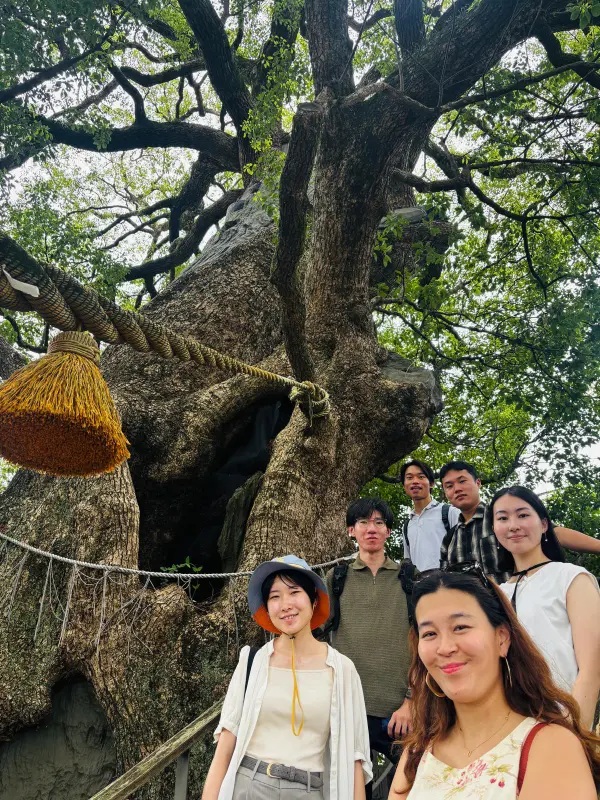
In Nagasaki, supported by Peace Boat interns and former High School Student Peace Ambassadors, we shared stories about the large camphor trees at Sanno Shrine and the Crow Prickly Ash tree at Shiroyama Elementary School. Additionally presented was an English language paper-picture show (kamishibai) by Sugahara Maki, who has conducted activities beneath the large camphor trees for 17 years. The stream reached an international audience and is still available online for viewers worldwide.
TPNW Forum: Exploring Paths for Dialogue
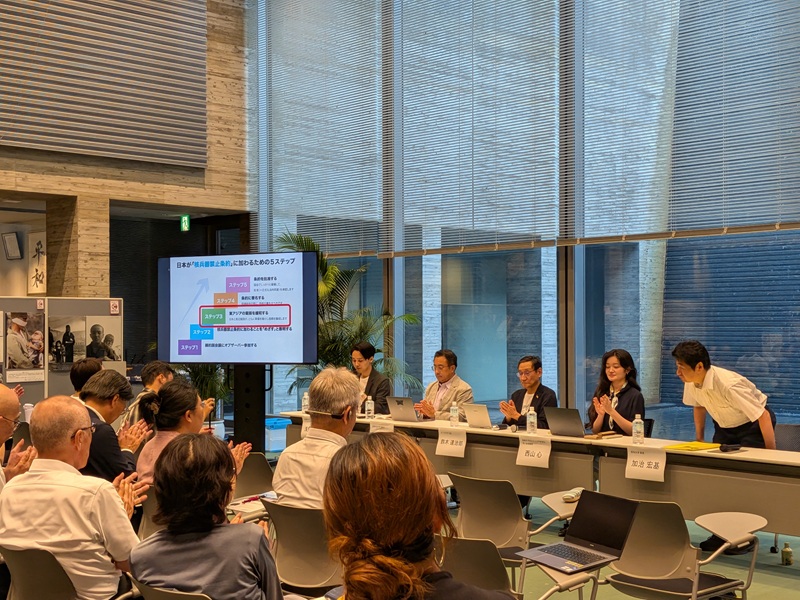
On August 7, the Japan Campaign to Abolish Nuclear Weapons hosted the "TPNW Forum" at the National Nagasaki Atomic Bomb Memorial Hall for Peace. Now in its third year, this forum adopted the theme "Toward a Nuclear-Free East Asia: Exploring Paths for Dialogue with China and North Korea." Suzuki Tatsujiro, Visiting Professor at Nagasaki University and Director of Peace Depot, delivered the keynote address, speaking on the vision of creating a system of common security in East Asia that does not rely on nuclear weapons.
In the subsequent panel discussion, Kaji Hiroki (Aichi University), Son Hyunjin (Hiroshima City University), and Nishiyama Shin (Nagasaki University Graduate School) joined to deliberate on the possibilities for dialogue with China and North Korea under challenging international circumstances.
Speakers highlighted the importance of building confidence, expanding civil society movements, and strengthening the norm against using nuclear weapons. In closing, Peace Boat's Kawasaki Akira emphasized the crucial role civil society plays as an active participant in building international trust.
On August 8, a celebratory gathering commemorating the 70th anniversary of Nihon Hidankyo's founding was held in Nagasaki, attended by Kawasaki Akira and Matsumura Masumi on behalf of Peace Boat.
ICAN: New Introductory Booklet in 17 Languages
In an effort to raise global public awareness about the grave and growing threat posed by nuclear weapons, ICAN has launched a suite of new educational materials in 17 languages, including the main languages spoken in all nine nuclear-armed nations. Peace Boat managed the translation of Japanese and other East Asian languages.
Topics include the catastrophic effects of nuclear weapons, the US nuclear bombings of Hiroshima and Nagasaki, the toxic legacy of nuclear testing, the state of nuclear arsenals today, the arguments for nuclear abolition, and the prohibition of nuclear weapons under international law.
The materials include personal stories of survivors of the nuclear attacks on Japan eight decades ago and of people harmed by nuclear testing at dozens of sites around the world. They also offer practical suggestions for actions that individuals can take to help bring the era of nuclear weapons to a permanent end.
Click here to access the booklet in full.
Connecting Hiroshima, Nagasaki, and the World
Currently, nuclear-armed states are engaged in nuclear arms expansion, and even within Japan, voices condoning nuclear weapons—such as calls to "revisit the Three Non-Nuclear Principles"—are emerging. However, precisely at times like this, Peace Boat will continue to deepen our partnerships with Hibakusha, civil society groups and peace organizations to communicate the importance of peace and nuclear abolition. Particularly, we will continue to intensify our activities toward the First Review Conference of the TPNW, to be held at the United Nations in New York from November this year.