

From the Ship
Connecting Generations: Onboard Peace Forums in 8 East Asian Ports
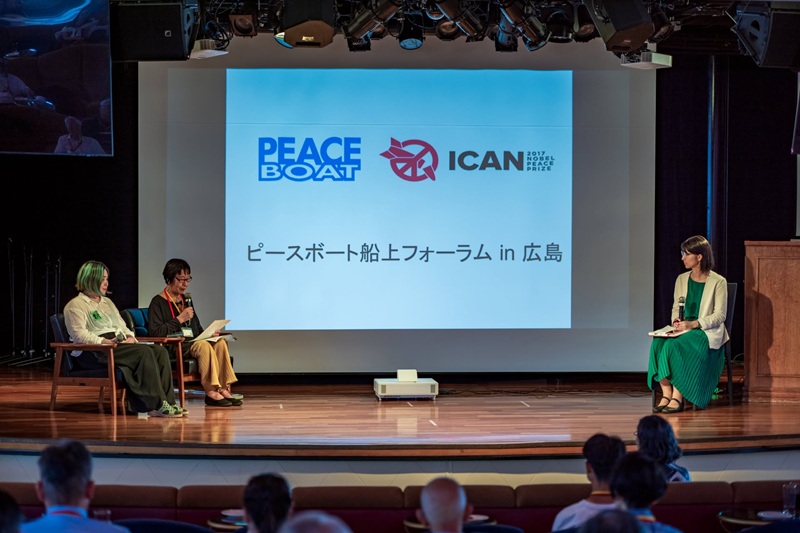
During the short voyage around Japan and several neighbouring countries during summer 2026, Peace Boat continued to work alongside Hibakusha (atomic bomb survivors) to convey the message for a world without nuclear weapons. Between July 26 and August 15, around 400 local community members, including many Hibakusha, visited the ship in 8 ports of call to join onboard peace fora and view the onboard outreach edition of the Nobel Peace Exhibition, “A Message to Humanity.”
The floating peace exhibition
“A Message to Humanity” was first installed at the Nobel Peace Center in Oslo, in commemoration of Nihon Hidankyo’s awarding of the Nobel Peace Prize in 2024. In order to bring the exhibition and its vital message to audiences worldwide, this outreach edition was installed onboard Peace Boat in April 2025 through a partnership with the Nobel Peace Center, and it has now been visited by thousands of people worldwide.
This voyage provided a valuable opportunity for many Hibakusha in Japan, including representatives of Nihon Hidankyo and their families, to see the exhibition first hand.
Sakuma Kunihiko, Chair of the Hiroshima Prefecture A-bomb Sufferers Organization (Hiroshima Hidankyo), expressed his high expectations upon viewing the exhibition, stating that "initiatives conveyed to people around the world in this unique space sea encourage people worldwide to act toward nuclear abolition, giving us immense strength." The exhibition was also visited by guests including Hiroshima Mayor Matsui Kazumi, Nagasaki Mayor Suzuki Shiro, Hiroshima Peace Culture Foundation Chairperson Kagawa Takehiro, and UNITAR Hiroshima Office Head Mikami Chisa.
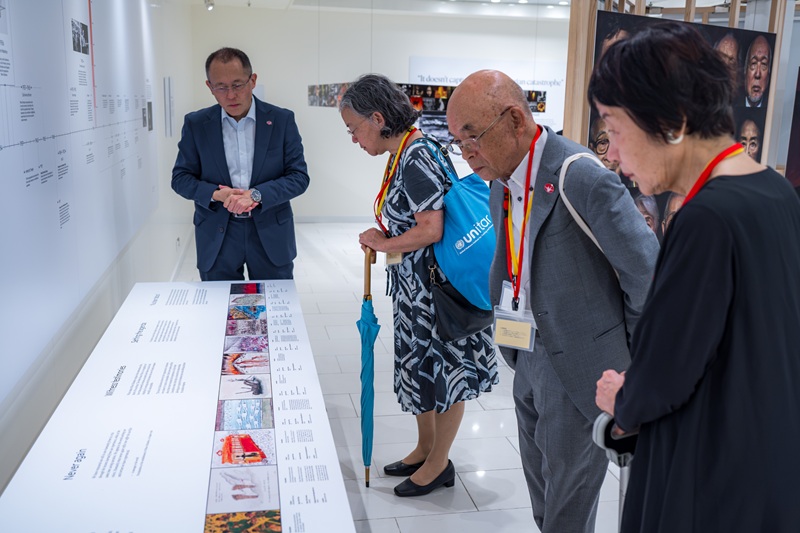
Mikami Chisa, Sakuma Kunihiko and Tanaka Toshiko visiting the “Message to Humanity” exhibition onboard (Photo: Nakaoku Takeo)
Reflecting on a World Without Nuclear Weapons in Local Contexts
The voyage visited both atomic bombed cities of Hiroshima and Nagasaki, as well as several other ports throughout Japan. In each city, fora were held tailored to local historical contexts and issues. During the call to Hiroshima (July 28), Hibakusha Tanaka Toshiko emphasized that personal bonds among citizens form the foundation to prevent war, stating, "I could never bring myself to drop a bomb on a friend's head. Hesitation is where serious diplomacy begins." Additionally, Abiko Erika, founder of the Social Book Cafe Hachidorisha in Hiroshima, highlighted the importance of personal encounters and dialogue while speaking on the theme of how to connect Hiroshima with the world.
During the call in Naha (August 2), the forum was held on the theme of Nuclear Threats and Okinawa. Hibakusha Hanagaki Rumi, who sailed on the full voyage as a Guest Educator, was joined by Okinawa-resident Hibakusha Nakahara Fumiko to reflect together on August 81 years ago. They then contemplated current security issues alongside participants including participants of the Okinawa High School Students Peace Seminar.
At the forum held in Nagasaki (August 4), passionate dialogues took place focused on connecting Nagasaki and the world, particularly on passing down the atomic bombing memories to younger generations. Mitamura Shizuko, a Hibakusha who has sailed twice with Peace Boat's Hibakusha Project, expressed a sense of crisis regarding current attitudes, saying, "war is treated like a game nowadays. We must return to the basics and teach the horror of war and the terror of nuclear weapons." Nakamura Keiko of Nagasaki University’s Research Center for Nuclear Weapons Abolition (RECNA) shared that "there are many generations worldwide who feel their lives were changed by Hibakusha," calling for as many people as possible to experience such encounters.
Furthermore, at ports of call in northern Japan such as Kanazawa (August 8), Otaru (August 10), and Hakodate (August 11), exchange events, picture-story shows (kamishibai), and testimony sessions involving local peace activists and students were held, sharing the importance of community-rooted peace action.
In Kanazawa, Nishimoto Tamiko, former president of the Ishikawa Prefecture A-bomb Survivors Association, delivered a powerful message stating, "we must not leave a negative legacy behind… I want to advocate for the abolition of nuclear weapons for as long as I live," sharing her determination and passion for peace with the entire audience.
In Otaru, a lawyer who worked on lawsuits for Hibakusha in Hokkaido shared, "hearing Ms. Hanagaki's story on the ship today reminded me of the experiences of the Hibakusha I have represented. Hearing once again the reality of atomic bombings directly reinforced my conviction that nuclear weapons and humanity cannot coexist.”
In Hakodate, a student who participated in the forum summarized in a report: "I want to learn about atomic bombs and war, and take them as my own personal issue. We all have a responsibility to pass this on and think about what we can do to change the current situation."
Deepening Peace and Dialogue in East Asia
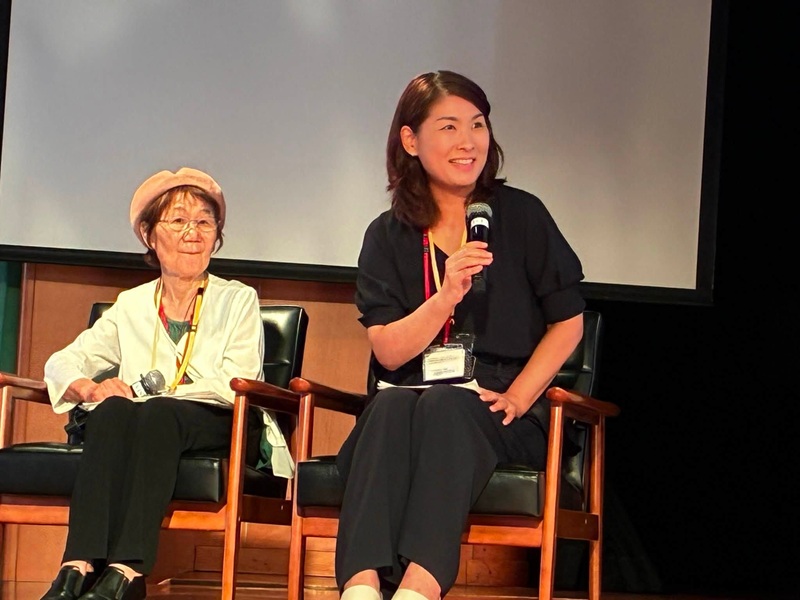
As well as ports throughout Japan, initiatives to deepen peace and dialogue in East Asia were also carried out as the ship docked in the port of Keelung, Taiwan (July 31), and Busan, South Korea (August 5).
In Keelung, an intergenerational forum organized in collaboration with the local civic group, the Lung Yingtai Cultural Foundation, brought together young people to explore the role of civil society toward denuclearization and peacebuilding in East Asia. Upon learning that the father of Hibakusha Hanagaki Rumi had passed away in Taiwan, the Taiwanese youth seemed to feel a closer connection to the Hibakusha, listening intently to every word.
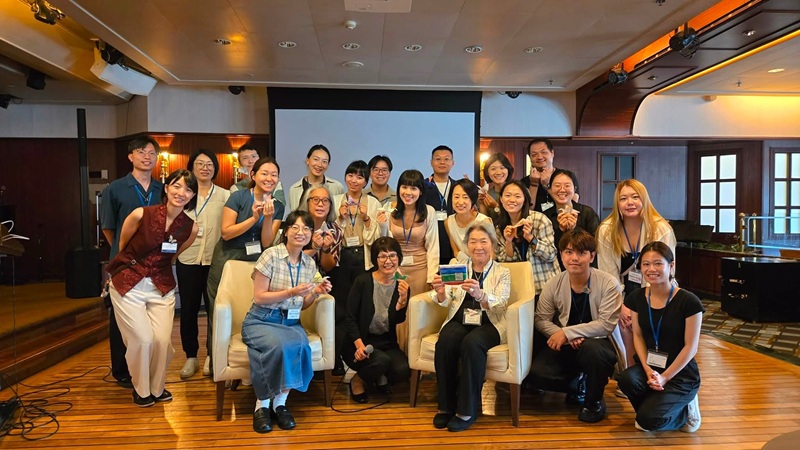
As Peace Boat docked in Busan, a delegation attended a memorial service for Korean victims and survivors of the atomic bombings, where they had the honour of meeting with Park Jungsoon, who was exposed to the atomic bomb at age 12, and Jeong Woonsul, who was an infant at the time. Following this we received a visit of Lee Taejae, representing second-generation Hibakusha, who was also part of Nihon Hidankyo’s official delegation to the Nobel Peace Prize ceremony in December 2024, as well as several students. This was an opportunity to deepen understanding of the situation of Korean Hibakusha, which is not widely known in either Japan or South Korea. This direct dialogue reaffirmed the importance of ongoing efforts for cross-border solidarity and mutual understanding rooted in historical context and recognition of Japan’s colonialist aggression.
These onboard fora contributed significantly not only to passing down memories and messages of the atomic bomb survivors to the future, but also to connecting grassroots citizens across Japan and East Asia and enhancing a network for continued joint actions toward peace.
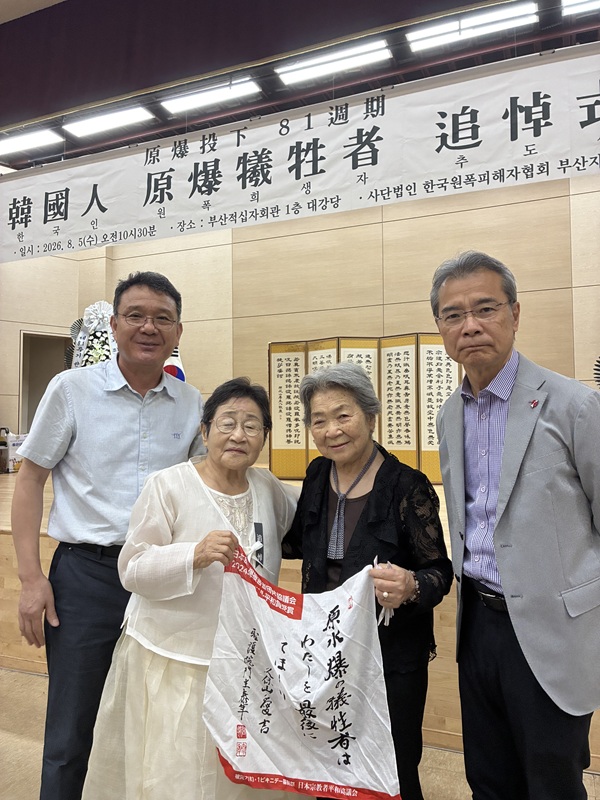
Park Jungsoon (second from left) and Hanagaki Rumi (second from right) at the Memorial Service for Korean Atomic Bomb Victims in Busan