From the Ship
Seeds of Change: The Galapagos Forest Revitalization Project
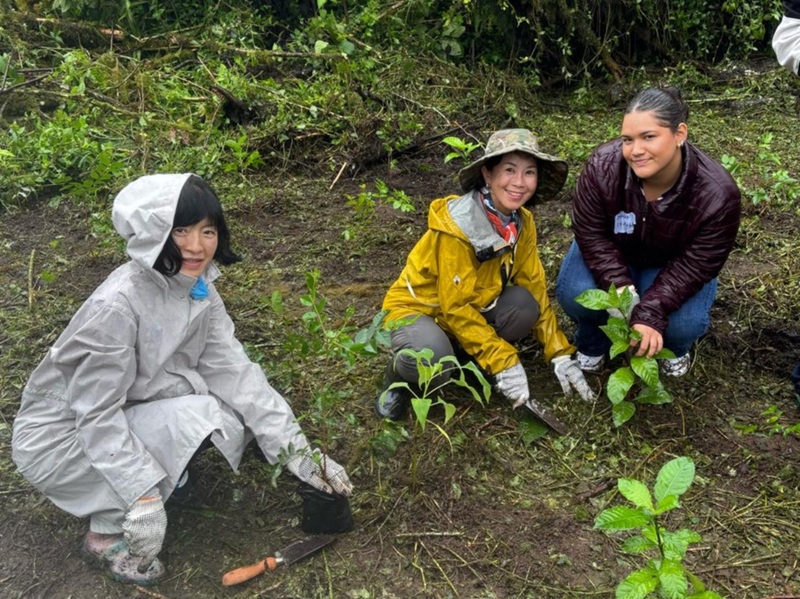
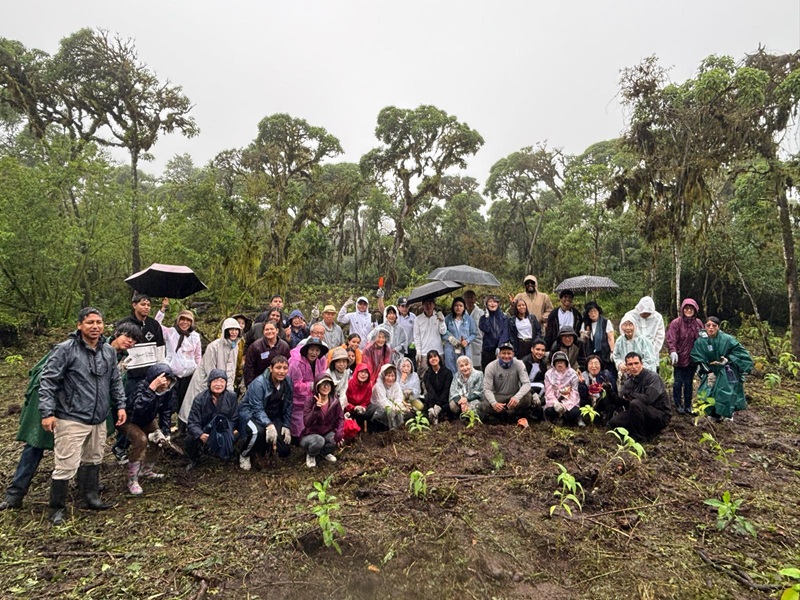
A group of participants from Peace Boat’s 123rd Global Voyage joined an overland study programme to experience the natural wonders of the Galapagos Islands. Located right on the equator about 1,000 km off the coast of Ecuador, this delicate sanctuary welcomed the group for a journey focused on conservation. After passing through strict biosecurity checks designed to protect the local environment, the participants rolled up their sleeves to plant trees alongside local high school students, contributing directly to the islands' unique ecosystem.
Encountering Tortoises: Charles Darwin Research Station
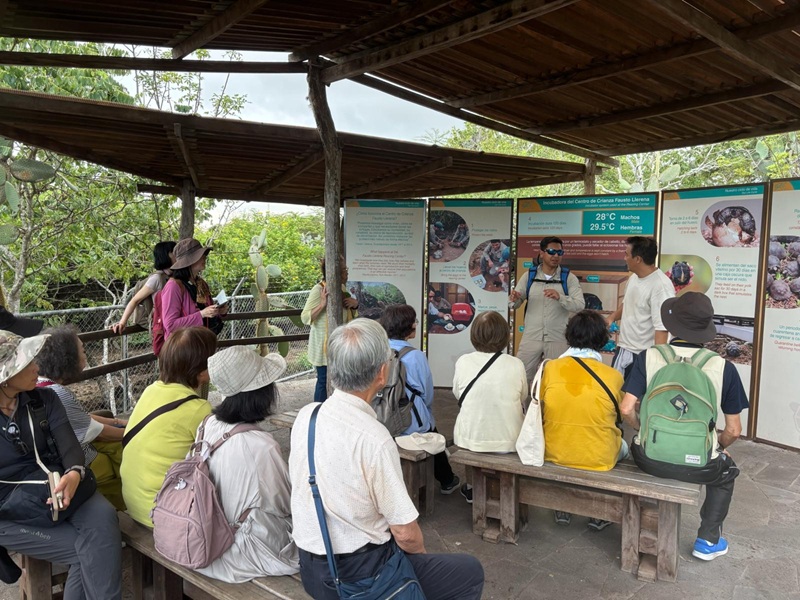
Upon arriving in the Galapagos, the first destination was the Charles Darwin Research Station. This facility conducts surveys, research, and nature conservation activities for the flora and fauna of the Galapagos Islands. Inside the facility, participants observed a variety of protected and reared Galapagos giant tortoises, ranging from palm-sized babies to massive adults.
In the exhibition room, they also viewed the taxidermy of "Lonesome George," the last survivor of the Pinta Island tortoise species who passed away in 2012. Confronted with the history of an extinct species, participants listened intently to the guide's explanation and joined an active discussion session.
Tree-Planting Activities for Endemic Species to Connect to the Future
In the Galapagos, the proliferation of invasive plants is a major issue, and tree-planting activities for endemic species continue in order to restore the original ecosystem. Participants joined together with local high school students to plant over 300 seedlings of the endemic Scalesia at two locations: the National Park and a coffee farm.
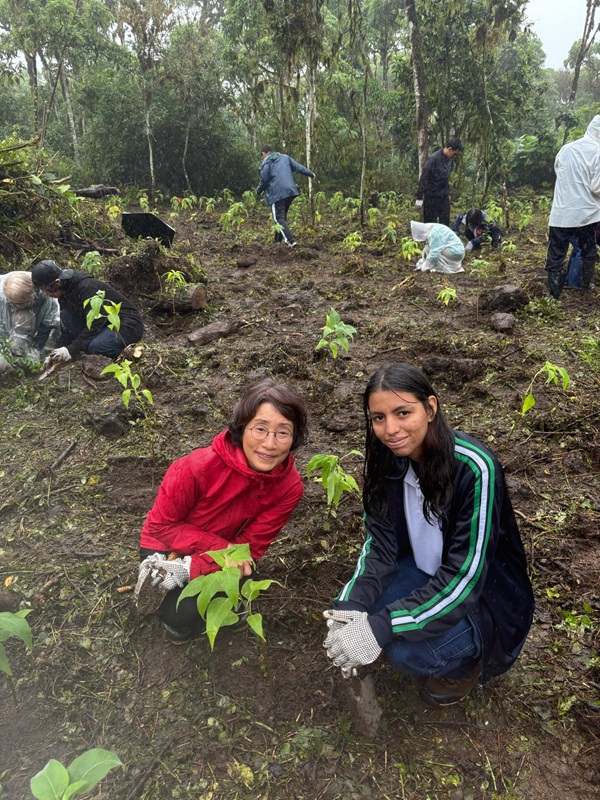
Although it was unfortunately raining on the day, the National Park staff had pre-dug holes for easier planting, allowing the work to proceed smoothly. Participants and students were divided into joint groups to carefully plant the seedlings together. The students had also created handmade wooden nameplates, with proceeds to go as donations to the high school, and participants together added their names and messages to the seedlings.
The Growth of the Forest and Exchange with High School Students
At the coffee farm, participants also viewed how the seedlings planted during Peace Boat’s visit a year ago have now grown to a height of over 3 meters. They were amazed by the growth speed of the Scalesia, highlighting how this activity is certainly connected to the forest of the future.
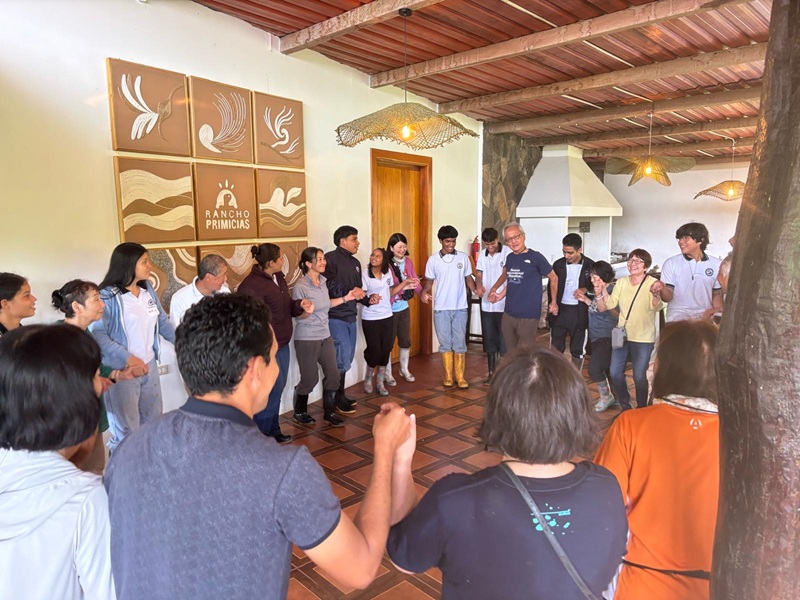
Between the tree-planting efforts, the group shared a meaningful break with the high school students, bonding over lunch and the art of origami. The atmosphere became even more vibrant when the students, together with their music teacher, shared a performance of local songs. This sparked an impromptu celebration, with participants and students alike joining in song and dance, creating a joyful moment of connection that effortlessly transcended language barriers.
Encounters with Wildlife: Feeling Environmental Changes Firsthand
The opportunity to view the nature of the Galapagos first-hand was an experience many participants had dreamed of for years. Over two days, they toured the islands by boat and observed wildlife unique to the islands, in small groups and accompanied by a nature guide, in line with local environmental protection guidelines.
On South Plaza Island, where rugged rocky areas and prickly pear cacti grow in clusters, participants observed land iguanas, sea lions, and the beautiful Swallow-tailed Gulls with their red eyes and legs. They also enjoyed encounters with animals such as sea turtles swimming on the surface during boat transfers.
This June was hotter than average, and despite it usually being a dry period, there were significant climatic changes such as rainy days, reportedly a possible precursor to a major El Niño phenomenon.
This influence was also visible in the flora and fauna. Usually, male land iguanas are surrounded by multiple females, but this year no such groups were found, and the number of land iguanas themselves was significantly lower than in usual years. It was explained that while this change in the ecosystem is different from normal years, it is not necessarily something purely negative, and can also serve to promote the metabolism of the island's ecosystem.
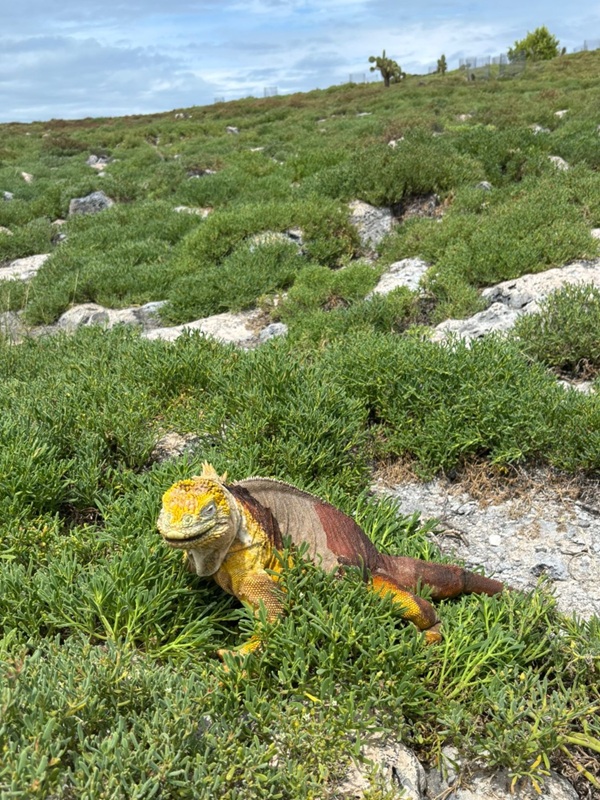
Land Iguana
On North Seymour Island, participants observed male Frigatebirds working hard at nest-building while holding branches to attract females, as well as inflating their red throat pouches. They also saw the Blue-footed Booby, a highlight for many.
The study tour provided a profound series of encounters with the region's wildlife and significant engagement with the local community. Following their return to the ship, participants reflected deeply on the experience, expressing a lasting appreciation for the visit and a firm commitment to preserving the ecological value of the Galapagos Islands.
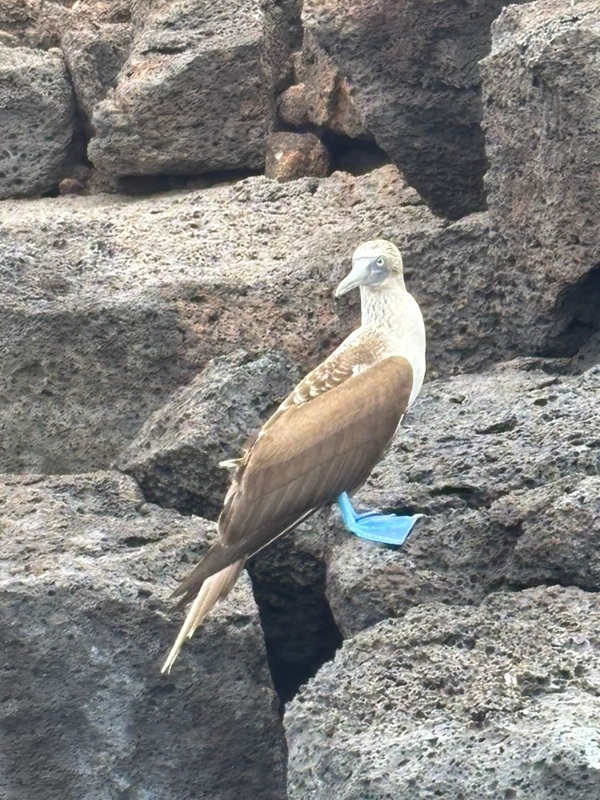
Blue-footed Booby
Galapagos Environmental Issues and Peace Boat
The Galapagos Islands were registered as the first World Heritage Site (Natural Heritage) in 1978. However, due to environmental pollution from an increase in tourists and residents, as well as the invasion of alien species, the maintenance of the unique ecosystem was considered to be in a critical situation, leading to its registration on the "List of World Heritage in Danger" in June 2007. Following this, conservation efforts were recognized, and it was removed from the Danger List in July 2010. However, environmental pollution remains serious today, and natural environment conservation efforts such as the eradication of invasive species and protection of endemic species are ongoing.
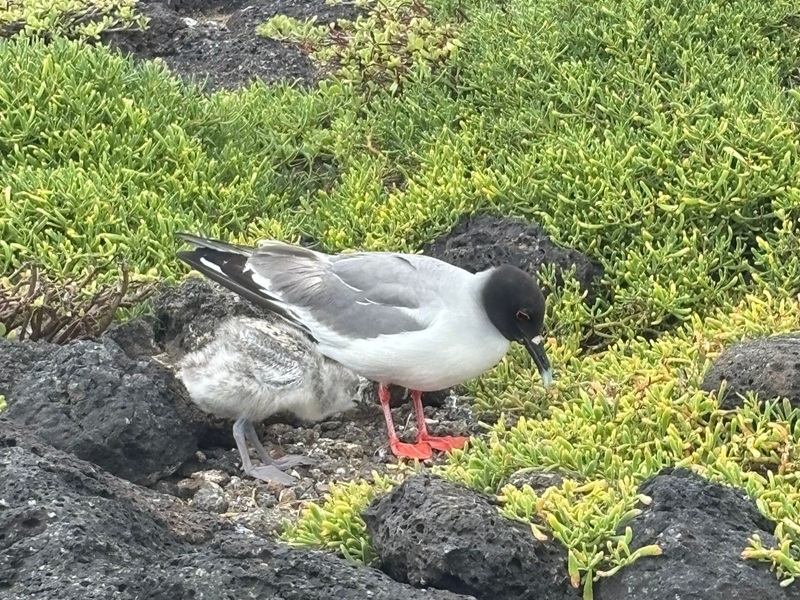
Swallow-tailed Gull Parent and Chick
Peace Boat launched the "Galapagos Forest Regeneration Project" in May 2007, the month before the Galapagos Islands were registered on the Danger List, together with renowned photographer Fujiwara Koichi, also Representative of the Galapagos Conservation Fund (Japan), and the local Charles Darwin Foundation. Recognizing the necessity of continued awareness raising and conservation efforts, Peace Boat has continued to conduct tree-planting activities with local organizations in the Galapagos Islands ever since.