

News
Press Release at COP31: Record military spending drives emissions that escape scrutiny in climate talks
FOR IMMEDIATE RELEASE
Record military spending drives emissions that escape scrutiny in climate talks
Civil society representatives and governments raised the climate costs of militarisation in their COP31 opening statements. A press conference will make the case for bringing military spending and emissions onto the UN climate agenda.
ANTALYA, TÜRKİYE, 11 November 2026. Global military spending reached a record US$2.887 trillion in 2025, rising for the eleventh consecutive year. Spending more on weapons production, military operations and infrastructure drives up greenhouse gas emissions and commits public resources that could fund emissions cuts, adaptation and responses to loss and damage. Yet emissions from military expansion largely escape scrutiny in the UN climate talks. SIPRI military spending data
Militaries and their supply chains account for an estimated 5.5 per cent of global greenhouse gas emissions, excluding emissions arising directly from armed conflict. Burning fossil fuels to power military aircraft, ships, vehicles and bases contributes to this footprint. That makes military fuel use directly relevant to the COP28 agreement to transition away from fossil fuels in energy systems. SGR and CEOBS military emissions estimate
Under the UN Framework Convention on Climate Change (UNFCCC), governments report some military emissions in their national greenhouse gas inventories. Reporting is uneven, and governments often group military emissions with other sources. This makes it difficult to tell how much militaries emit, whether those emissions are rising and what governments plan to do to cut them.
At the COP31 opening plenary, civil society representatives and governments raised military spending and emissions in their opening statements. That followed a challenge from Murat Kurum at the pre-COP meeting in Fiji. “What does it mean to spend 5% for defence if you don’t have a country to live on?” he asked, urging governments to bring the same determination to climate action as they bring to defence spending. Reuters reporting from the Fiji pre-COP
The press conference will make the case for following up those opening statements in the negotiations. Speakers will examine how military systems, from arms procurement and production to bases and operations, generate emissions and shape public spending. They will discuss how the UNFCCC can address these impacts through more transparent emissions reporting, national climate plans and discussions on climate finance.
The discussion will also consider how armed conflict undermines communities’ ability to adapt to climate change. When war destroys water systems, farmland and public services, people lose resources they depend on to cope with drought, floods and extreme heat. The 2026 Civil Society Equity Review, Militarism in the Time of Climate Emergency, will inform the discussion on how militarism compounds climate risks and undermines equitable climate action.
Press conference details
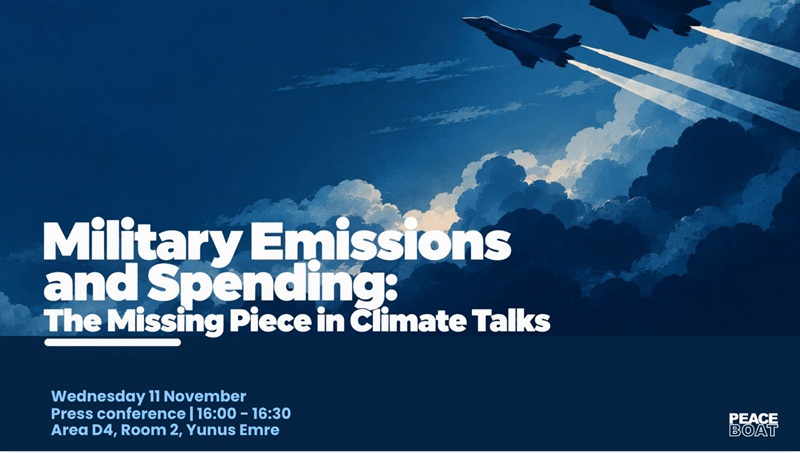
Title: Military Emissions and Spending: The Missing Piece in Climate Talks
Date: Wednesday, 11 November 2026
Time: 16:00–16:30, Antalya local time
Venue: Area D4, Room 2, Yunus Emre, COP31, Antalya
Host: Peace Boat Disaster Relief
Moderator: Karen Hallows, Peace Boat and Thematic Co-lead on Peace and Demilitarisation, Women and Gender Constituency
Speakers
-
Tasneem Essop, Executive Director, Climate Action Network International
-
Mohammed Usrof, Palestinian Institute for Climate Strategy (PICS)
-
Sivan Kartha, Civil Society Equity Review
-
Deborah Burton, Tipping Point North South
-
Rae Junsay, Peoples Rising for Climate Justice, Global Campaign to Demand Climate Justice (DCJ)
-
Laura Guzman, Co-founder, Tierra Nuestra
Media contact
Karen Hallows, Peace Boat
karen@peaceboat.gr.jp
+44 7804 761389 (phone and WhatsApp)
ENDS