

Statements
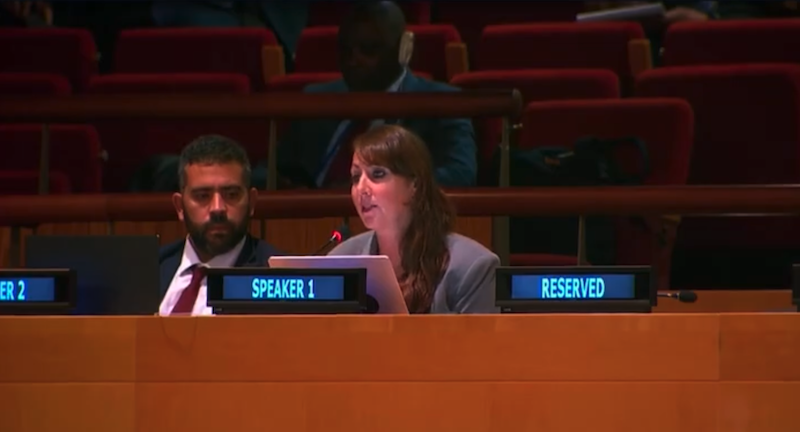
Statement by Peace Boat at the International Meeting on Victim Assistance and Environmental Remediation
Distinguished delegates,
Peace Boat welcomes the first United Nations meeting on nuclear victim assistance and environmental remediation. As a Japan-based international civil society organization, Peace Boat has travelled since 2008 with over 170 Hibakusha (atomic bomb survivors of Hiroshima and Nagasaki) and other global nuclear survivors.
Lessons from Japan's Hibakusha Relief System
When considering international support, understanding Japan’s relief system for Hibakusha is crucial. While providing meaningful medical support, it has significant limitations offering valuable lessons.
First, is the recognition that Japan provides relief for Hibakusha, not State compensation. Nihon Hidankyo, the national confederation of survivors, has continuously called for State compensation acknowledging government war responsibility, which remains unrealized.
Second is the issue of official recognition. Survivors certified by the government are issued an Atomic Bomb Survivor's Certificate, and in principle therefore are eligible for free medical care. However, people beyond specific geographic bounds from the hypocenter were excluded, sparking long-standing litigation by local residents. In 2021, a political decision in Hiroshima recognized "black rain" victims, though this issue remains unresolved in Nagasaki.
Disputes over the scope of certification closely connect to evaluating internal radiation exposure, which must also be considered in victim certification decisions.
Third is the certification of 'atomic bomb disease' for survivors who develop specific illnesses like cancer or leukemia. The Japanese government grants certain allowances to the individual in the case of such certification. However, Hibakusha organizations have long disputed this system, arguing that the scope is too narrow and the criteria too strict.
Fourth, is relief for non-Japanese and overseas Hibakusha. Japan’s colonial rule until 1945 brought many non-Japanese people, including from the Korean Peninsula, to Hiroshima and Nagasaki, where they consequently experienced the atomic bombings. Postwar, they ceased to have Japanese citizenship and were excluded from relief. Hibakusha among the many Japanese emigrants to the Pacific and Americas also received either no or only limited relief. Through repeated lawsuits, these groups eventually gained legal recognition equivalent to Hibakusha in Japan.
The starting point for all victim assistance is defining who is recognized. Japan’s experience shows that while official definitions may be narrow, victims themselves as well as civil society in affected areas advocate for broader rights. Civil society and diverse impacted voices must therefore be involved in the design of victim assistance policies.
Furthermore, nuclear harm extends beyond the effects of radiation itself. Hibakusha are also victims of war, suffering blast and heat injuries alongside destroyed infrastructure, families, and communities, resulting in long-term social, economic, psychological, and intergenerational impacts.
In this context, a gender perspective is also vital. Women and girls are not only particularly vulnerable to the effects of radiation, but have also experienced caregiving burdens, psychological impacts, and gender-based violence.
These points reaffirm that victims and affected communities must continuously participate in the design and implementation of all nuclear victim assistance systems. The voices of those with lived experience, as well as those who find it difficult to speak out, must be listened to actively.
Principles of International Cooperation
We recommend that countries, including Japan, exchange information in order to verify, evaluate and compare existing assistance systems and identify improvements.
We call on countries that have used or tested nuclear weapons to share detailed information regarding these actions, and for all data on damage and environmental contamination to be shared with victims, affected communities and countries.
We welcome discussions within the framework of the Treaty on the Prohibition of Nuclear Weapons (TPNW) toward the establishment of an international trust fund for victim assistance and environmental remediation, and encouraging all countries, including those not yet party to the TPNW, to participate actively in the upcoming Review Conference.
Thank you.