

Statements
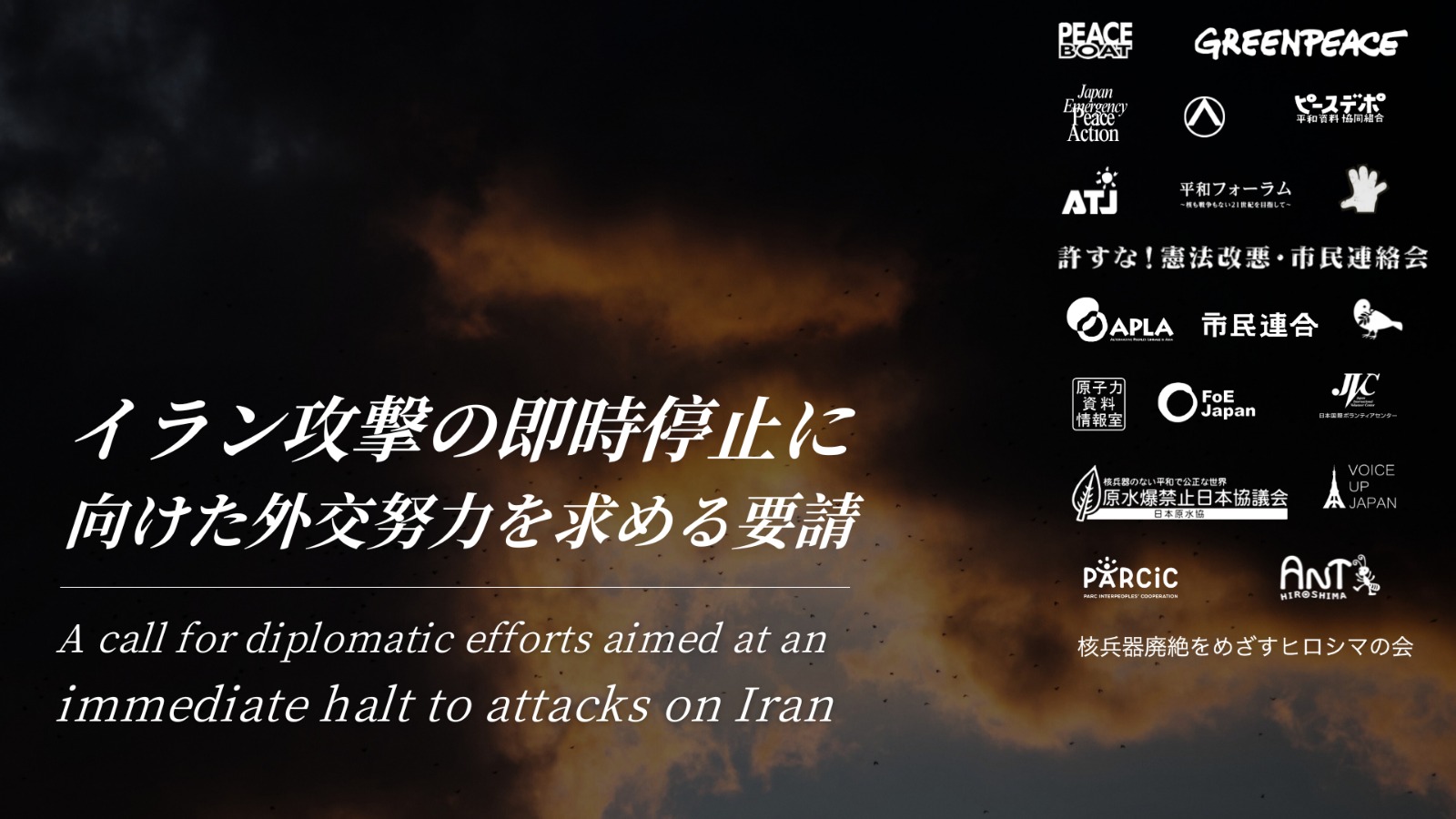
20 Japanese NGOs call for diplomatic efforts toward an immediate halt to attacks on Iran
On March 18, Peace Boat, in coordination with 19 other NGOs and civil society organizations, submitted the following letter to Prime Minister Takaichi Sanae. This formal call was issued ahead of the Japan-U.S. Summit scheduled for March 19 and was delivered via postal mail and the official online message portal of the Prime Minister’s Official Residence.
Prime Minister Takaichi Sanae
A Call for Diplomatic Efforts Toward an Immediate Halt to Attacks on Iran
The United States and Israeli military attacks on Iran have reportedly caused more than 1,300 civilian casualties within Iran, including countless deaths of children from U.S. airstrikes on an elementary school. With Iran’s following strikes on neighboring countries and Israel’s attacks on Lebanon, the entire Middle East region is being brought into catastrophic warfare. The impact on the global economy is immense, and the whole situation demands immediate action.
Moreover, crude oil spiles, fires and bombings are releasing massive amounts of greenhouse gases and hazardous chemicals which are contaminating our waters, air, soil and entire ecosystem. The World Health Organization (WHO) has acknowledged the existence of black rain due to the air strikes on Tehran oil facilities, causing lasting health damage and serious air pollution. War is the most severe form of environmental destruction: it leaves lasting health damage for future generations, devastates ecosystems and accelerates the climate crisis.
The most recent polls in Japan show that the overwhelming majority of the population “does not support” these military attacks. We urge Prime Minister Takaichi as she prepares to meet the U.S. President Donald Trump on March 19 in Washington, D.C. to strongly urge the following points, demonstrating a firm and resolute diplomatic stance.
1. Complying with international law and an immediate ceasefire
The ongoing military attacks are a clear violation of Article 2 (4) of the United Nations Charter which prohibits the use of force against sovereign states. Continuous military attacks while ignoring international law only brings a spiral of further chaos and hatred. We call on the Japanese government to strongly urge the U.S. to immediately halt its military attacks on Iran, and to call on Israel to immediately halt its military attacks on Iran and neighboring countries.
We are also deeply concerned at Iran’s retaliatory strikes that are causing civilian casualties and endangering the lives of civilians. Therefore, we also call on the Iranian government to cease such actions. However, it is clear from the course of events that to end the current crisis, the U.S. must first stop its attacks.
2. Rejecting military cooperation and financial support
Japan must not cooperate nor contribute to this U.S.-led war. U.S. Marines are reportedly being deployed to Iran from U.S. military bases in Japan, and President Trump has expressed expectations for Japan to dispatch Maritime Self-Defense Force vessels to help secure the Strait of Hormuz. However, Japan must not dispatch the Self-Defense Force, and must also refuse any financial support for military operations due to the following reasons.
-
Lack of legal basis: Even setting aside the question of the unconstitutionality of the 2015 security legislation, there is no legal basis in the Japanese Constitution nor current law that could justify deploying the Self-Defense Forces to support these military actions. Such undertaking is thus legally impossible to implement.
-
Danger on the ground: Deploying the Self-Defense Forces into an expanding war is too dangerous and would expose undue risk to the lives of service members.
- Diplomatic cost: If Japan provided support, including financial, it would undermine Japan’s positive relationship built with Iran over decades, as well as the trust of other countries of the region and more broadly from the Global South.
3. Ensuring energy security and economic stability
The stability of the Strait of Hormuz and a stable supply of crude oil and LNG are critical issues for Japan. However, what is needed to achieve this is not complicity in the war, but bringing it to an immediate stop. An escalation of the war is the greatest risk of destruction of supply chains, and the only path to guaranteeing Japan's energy security is a peaceful resolution to this conflict.
In the long term, we must also transition away from a society that depends on fossil fuel imports.
4. Resolving nuclear issues through diplomacy
The grounds of the military attack was declared to be the nuclear development of Iran. This is a serious matter, but it must be resolved through diplomacy. Military force can not resolve nuclear issues. First of all, both the U.S. and Israel hold nuclear weapons. The U.S. bears an obligation under the Nuclear Non-Proliferation Treaty (NPT) to pursue nuclear disarmament, and Israel has been called to disclose information about its own nuclear arsenal. If the current situation continues, the international nuclear non-proliferation regime itself will be destroyed.
In 2024, the Nobel Peace Prize awarded to Nihon Hidankyo (the Japan Confederation of A- and H-Bomb Sufferers Organizations) reminded the world that nuclear weapons are weapons of "absolute evil”. We urge you to persuade the U.S. to resolve the issue of Iranian nuclear development through diplomatic means, including through the NPT Review Conference starting next month and the process of the Treaty on the Prohibition of Nuclear Weapons (TPNW).
Blindly following or deferring to a partner nation when they are in the wrong is not the conduct of a responsible nation. Now, as the international rule of law is in crisis, the true value of the diplomacy of Japan, which has championed itself as a “nation of peace,” is being tested. We must stand on the right side of history. We strongly urge you to pursue diplomacy that will truly lead to the safety of citizens, and the stability of the international community.
March 18, 2026
Alter Trade Japan
ANT-Hiroshima
APLA
Citizens' Liaison Group against Constitutional Reform
Citizens' Nuclear Information Center (CNIC)
Civil Alliance for Peace and Constitutionalism (Shimin Rengo)
FoE Japan
Greenpeace Japan
Hiroshima Alliance for Nuclear Weapons Abolition(HANWA)
Japan Congress against A- and H-Bombs(Gensuikin)
Japan Council against Atomic and Hydrogen Bombs(Gensuikyo)
Japan Emergency Peace Action
Japan International Volunteer Center (JVC)
Japan Peace Committee
PARC Interpeoples’ Cooperation (PARCIC)
Peace Boat
Peace Depot
Peace Forum
Voice Up Japan
WE WANT OUR FUTURE
(20 organizations, in alphabetical order)